
The much ballyhooed search-and-display convergence has been lighting up the digital airwaves for over a year now as startup companies either enter the space looking to provide a solution, or media agencies, search engine marketers, ad networks and DSPs add the search-display channel to its offering.
Yet, it remains early days for a publicly available, truly integrated, cross-channel solution. Behind the curtain, I’ll guess big, smart e-commerce companies like Amazon are effectively doing it themselves. GSI Commerce is obviously trying to get its arms around it with this week’s acquisition of ClearSaleing. Others trumpet their solutions. And, of course, there is Google.
The goal is to provide the marketer with a clear understanding of all the touchpoints up and down the funnel within a search-and-display campaign to get a sense of appropriate attribution for each marketing tactic – each cookie, each display ad, each landing page (URL) and/or each keyword phrase. With this information in hand, the reasoning is that the marketer will open the pocketbook as they spend according to the attribution model, which will lead to more conversions, revenue, etc.
But it’s clear. Search-and-display – it’s not so simple.

What’s Simple: Search Retargeting
The first step to bringing the two channels together for many marketers has been search retargeting. (FYI, Search retargeting is the Google display ad knockout blow. Read this AdExchanger.com classic post! ) This makes perfect sense. It’s the proverbial low-hanging fruit.
To review, with search, bottom-of-the-funnel intent is captured from users, which is the reason Google makes all those billions by running relevant ads when you most want to see them –when you’re showing your interest in a particular topic, product or service.
Search retargeting in display advertising allows the marketer to re-message the consumer after they have input keywords in a search engine and shown intent.
Today’s search retargeting can work in different ways. One example: you put “new samsung phone” in Google (or any other search engine) and then you click a PPC ad or you click an organic search listing and you visit a landing page.
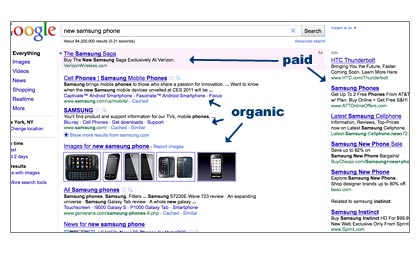
Assuming the landing page has a pixel placed by the marketer, you’re cookie’d and the keywords on which you “rode” can be attached to that cookie. That’s valuable data and a powerful signal – retargeting time!
So, the marketer says, “Mr. Sulu, prepare the display ads!” as she or he uses the cookie to retarget website display ad placements available through an ad exchange, ad network, aggregator or a publisher. With the appropriate message, the marketer looks to convert the user who has just shown intent – which is almost always time sensitive.
Search retargeting is step one of search-and-display. And, it works. The trouble is – no scale.
One way to go, is to increase scale through the purchase of look-a-like cookies which are matched along various attributes to the cookies set on marketers’ landing pages. As marketers become increasingly sophisticated, this will be another important layer. Certainly, there’s complexity here too as the look-a-like cookies exhibit behaviors similar to the target, but maybe not exactly like the intended target. The consumer behind these cookies will need to be driven down the funnel to conversion.
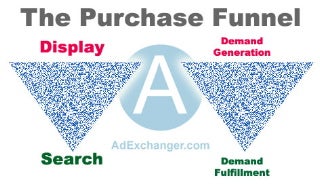
This is a microcosm of where search-and-display really needs to go: the domain of television. Generate or create the demand – not just fulfill it. It’s time for prospecting and working down the funnel rather than up!
What’s Hard: Prospecting

O.K., the graphic is a bit of an over-simplification but you get the point. The little blue dots are the consumers in the funnel.. there’s a lot more closer to display (on websites) than search.
For display-driven, search-and-display, the three levers of optimization interplay in hopes of successfully prospecting for conversions:
- Creative – The display ad itself… its message, the colors, the rich-ness (text, graphical, video). Much different demand generation messaging than search retargeting where the message speaks to intent.
- Context – A website or URL… The landing page informs on the audience, potential intent; layouts can affect creative (above or below the fold, etc.); lots of variables as websites across exchanges, aggregators and ad networks become landing pages.
- Audience – The cookie… as the user is shown messages within context of websites, intent is hopefully built. The sequencing of messaging can become important – whoa, I don’t hear of a lot of that going on – where the consumer sees ads that build on a story and gradually create intent.
The complexity (and opportunity) doesn’t stop there for the marketer…
In the end, the display-driven, search-and-display consumer is guided to search for a paid search or a listing courtesy of organic search (search engine optimization). Or the consumer goes right to the branded website.
Let’s hope anyway!






