

 The marketing cloud landscape has taken big steps into advertising technology and media buying, as with Oracle’s recent acquisitions of Moat and Grapeshot or Adobe’s deal for the video DSP TubeMogul.
But Salesforce defies that trend. The company has deferred to partners to provide online advertising. And while rival clouds contend for new data sources, Salesforce positions itself as perennial integrator.
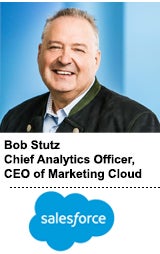
“For us, it’s more broadly about engagement between our customer and their consumers,” said Bob Stutz, CEO of Salesforce Marketing Cloud.
AdExchanger spoke to Stutz about his growth plans for the cloud marketing business – and how Salesforce differentiates itself from a competitive field of cloud tech giants.
AdExchanger: How do you go to market these days with the marketing cloud? And how has that changed?
BOB STUTZ: We’ve always talked about it as a consolidated solution. At the end of the day, companies have to do sales, to do ecommerce, any mix of B2B or consumer business. The collaboration across clouds is central to everything we’re doing.
In any company, there are multiple integrations with different systems, and that’s an opportunity. The key is to tie stuff together.
With MuleSoft, there’s an added element with this great way to bring in other third-party data or disparate sources.
And we’ve seen a shift in situations where previously, we were dealing with the CMO, and now that’s often moved up to the CEO. There are things like customer acquisition, retention for companies with users or contract deals, ecommerce, prospecting, where it’s not just the CMO anymore.

Is the end state a single, consolidated cloud offering?
It is ultimately the Salesforce cloud. But we have to respect that customers work with others, and we have to be part of integrated systems.
It makes sense to have the Marketing Cloud in a mar tech landscape where companies have hundreds or more than 1,000 applications running in their marketing departments and you have to integrate with pretty much everyone.
It’s about what problems they need to solve, not just going in to sell six different clouds.
Where does paid media fit in for you?
It’s a partner aspect for us.
If you look at what our DMP does today, we have relationships with publishers that allow data to be brought in similarly to an Oracle Data Cloud. But on the DSP side of the house, it’s an ecosystem, not a product.
Other marketing cloud companies are taking on data assets and measurement, and Salesforce seems to have more of a partner-integrator approach there too. Are there data assets in your future?
On one hand, we have Data Studio, a second-party tool for customers to share data in an anonymous way. Like how Warner Bros. had a movie about boxing and could go to HBO and share segments on weekly boxing viewers to help enrich its audience. Some publisher data is available in that way too.
But it is like paid media, where we’re probably connecting or sending data to another company.
It sounds like a CDP. What do you think of that category?
Frankly, I think that’s mostly marketing. We have all the pieces of a CDP, but really, what is that?
I think it’s a passing fad. Or really more of a temporary state as people are looking beyond a DMP, the connection to a CRM and evolving to mobile. It’s what people are doing already.
What I think you’ll see in a couple years is that many of the three-letter acronyms will go away and these things will blend together in a more seamless way. If you look at enterprises today, there are still a lot of siloes: customer service, sales, marketing, distribution, commerce. You can connect the data and collaborate, but it takes a lot of work to do that. But that’s the direction.








