
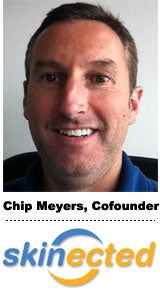
 Skinected is a young company, and small, with just five employees. But the pain point that spawned the business goes back some 15 years, and has plagued legions of media brokers and buyers.
Co-founders Chip Meyers and Stefan Kosel began trying to integrate non-standard ad formats into movie websites in the late ’90s, beginning with Godzilla.com in 1997. Meyers says the two found it “very difficult to deploy and traffic custom integrations across multiple publishers.”
With the launch of AppNexus Marketplace in 2011 the two decided to have a go at empowering buyers and sellers to transact on high impact, non-standard ad units using real-time bidding as the cornerstone.
Chip Meyers spoke with AdExchanger recently.
What problem does Skinected solve?
Stefan and I found it very difficult to deploy and traffic custom integrations across multiple publishers. We wished we could traffic custom ads like we could do with 300x250s. We decided we were going to solve that problem so that when you deploy and traffic a custom ad, it would be as automated as it was for standard ads. When real time bidding started taking off that really rang a bell in our heads. We said this is where we want to focus — enabling the buying and selling of these high-end custom ads programmatically via RTB platforms.

Our focus is strictly RTB programmatic. You don’t need us if you have a very large audience at one site, and you have a sales team. You probably don’t need us because we enable this to be scaled across multiple publishers in an automated fashion.
For the large ad network that represents thousands of publishers — this is where we can help. How do you enable 3,000 publishers to accept a high-end custom ad? You have to go to each one individually, one-by-one, and you’d have to get the webmaster or whoever is running that site to work with you. It’s a six-month process, and there’s a lot of cost and time.
We can enable those 3,000 publishers instantly to accept whatever ad is sold that is non-standard. This is based on two years of experience figuring out every different scenario, every different browser, every [device], and making sure the impressions are going to be viewable. That’s really what we do: make sure that these ads are viewable because a lot of times you’ll see a custom ad that’s not viewable, and someone’s paying for that.
A lot of people will come to me and say, they have 10 million impressions per day, and I say, “Well you’re not going to have 10 million viewable high-impact custom ad impressions a day,” I just want to let them know, it will be maybe only half of that because we kill off a ton of impressions that will not work.
That’s our competitive edge. Its focus is primarily, like I said, on RTB programmatic. That is it. We’re not interested in the manual process and helping a publisher that has maybe three different sites. I mean they can do this themselves. It’s really worked because of scale.
What was the timeline for the business?
About two years ago we started focusing on the development piece. Then we started to craft the RTB strategy, basically when AppNexus launched its Marketplace over a year ago. It was amazing for us to be able to innovate using an infrastructure that really was going to do most of the work for us, and we could be left to seamlessly integrate our technology into their platform for buyers and sellers. That made the direction much clearer.
It sounds like you came at this initially from the publisher perspective. Are you selling into the buy side as well?
We evangelized this to both demand and supply partners. We go to the brand itself and the demand filters down to agencies and trading desks. On the publisher side, we pitch the networks and then the premium publishers directly.
But really none of those is our customer. We do deals with AppNexus and other platforms. What I do is make people aware that are using those platforms. “Hey, by the way, you can now buy and sell your high-impact ad inventory programmatically.’ Everyone is always like, “I can? Wow, I didn’t know that.” They’re not even directing these dollars to the trading desk because they’re not aware that they can do this.
That’s basically what I’ve been doing the last six, seven months is meeting with buyers and sellers on both sides, that want to do less ads, but higher-impact ads.
What can you say on profitability, revenue growth, customers?
We are profitable. We have 60 or 70 installs from various supply and demand partners on AppNexus. A lot of those are [recently activated] and really just getting their feet wet. We launched our app back in April or May, and it really started to take off in September, and we’re starting to see more business through that.
What’s your revenue model?
We get a piece of the process. If they bid and it’s consummated, we get a piece of that, and then we really get paid by the platforms. Appnexus is facilitating that payment, and then they pay the supply and then out of that we get a small piece to help facilitate that.
From the buyer’s standpoint, there’s no cost.
Is it hard to get mindshare with agency buyers since you’re a small team?
Yes, it’s very difficult. What I have found to be effective is going directly to the brand because the brand tells the agency what to do.
A lot of people would have a hard time getting those meetings. What’s the secret?
It’s funny. The secret is really just kind of trying. There’s so much information out there and so many different people that you know. It’s six degrees of separation. It’s just identifying certain people that are out there from a brand standpoint that are looking to do innovative things… going to conferences, hearing people speak, hearing their names, and getting a referral. I think a lot of people just don’t try.






