The second quarter was what you might call an interesting one for Alphabet – especially if you care about advertising.
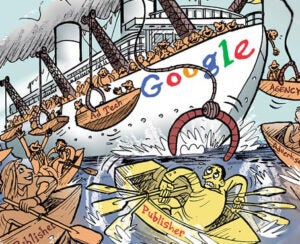
Google’s Network advertising business, which constitutes ad spend across the open web, was down year over year once again.
Meanwhile, in early July, Google lost a years-long appeal against a record 4.1 billion euro antitrust fine in the EU, which is roughly $4.7 billion. Oh, and a critical mass of important publishers are seriously reconsidering allowing Google to scrape their sites.
Even Reddit is now weighing whether it’s worth working with Google – which is truly tragedy as comedy, considering that Reddit signed a $60 million data licensing deal with Google in 2024 and has been the token example of a non-Google-owned site that’s benefited from Google’s search ranking overhaul since then.
Not that Google’s strife with pubs came up during Alphabet’s Q2 earnings call on Wednesday. In fact, the word “publisher” wasn’t mentioned once during the call, although “TPUs” – tensor processing units – came up 28 times.
But the investor call did underscore how, in many ways, this is a fundamentally different Alphabet than the ad industry has known before – one where questions about the open web and advertising are seemingly secondary.

Case in point, the words “advertiser,” “advertisers” and “advertising” combined only showed up 21 times during Alphabet’s call and only during the scripted remarks.
Investors didn’t once bring up Google’s advertising business or ads in general during the Q&A portion of the call. The topic was raised fleetingly in response to the second-to-last question, when SVP and Google Chief Business Officer Philipp Schindler highlighted advertising as an example of how the company is “applying Gemini models really across our entire ads infrastructure, whether it’s ads quality, advertising tools, [or] new AI experiences.”
Schindler also noted in his prepared remarks that AI Max, Google’s AI-based bidding product for search and shopping campaigns, “has become the core building block for advertisers to fully participate in our new AI experiences,” including on average a 50% improvement in overall conversions or ROAS.
He also cited AI Mode, Google’s fully AI-ified search engine experience (as opposed to AI Overviews, which generate AI responses atop traditional search response pages), as the latest addition to its billion-plus-user app portfolio, alongside Gmail, YouTube, Google Maps, the Google Play Store and Chrome.
This new Google also has a different kind of balance sheet. For example, Google is blithely and deliberately racking up debt.
“We have expanded our debt portfolio quite significantly over the past 12 months,” said CFO Anat Ashkenazi. Which is a funny way to say that Google has increased its debt from $16 billion to $100 billion across multiple currencies and geographies.
Google can afford to take on so much debt because its revenue base has ballooned. Alphabet’s Q2 2025 revenue total was $96.4 billion, which was the last time it failed to eclipse $100 billion in a quarter. Its Q2 earnings this year totaled $119.8 billion.
Another difference on the balance sheet is that Google Cloud is starting to crank up monetization. The company’s cloud revenue jumped from $13.6 billion in Q2 2025 to $24.8 billion during the past quarter, an 82% growth rate on an already sizable revenue base.
Oh, and another important factor is that Alphabet’s net income (aka profit) has increased stratospherically. Alphabet earned $28.2 billion in net income in the year-ago quarter, up more than 20% from Q2 2025. That’s an eye-popping number. But, hey, Alphabet turned a profit of more than $112 billion last quarter.
What? How?
We hear you. This is a truly wild spike in profitability driven by an increase in Alphabet’s “equities securities portfolio,” Ashkenazi said. Which is a reference to Alphabet’s $900 million early investment in SpaceX, which just paid off with SpaceX’s recent IPO.
Meanwhile, back on Earth, YouTube advertising rose from $9.8 billion in Q2 2025 to $11.1 billion during the span of one year. But who even cares about ads?
Not investors.
When Goldman Sachs Managing Director Eric Sheridan asked how Alphabet thinks about allocating TPUs, he framed it as a balance between Alphabet’s own need for AI data compute and selling bandwidth to Google Cloud customers.
In response, Alphabet CEO Sundar Pichai said the company’s first priority is to provide the TPUs it needs to compete with other frontier AI models and achieve AGI – “artificial general intelligence” – which is an unquantifiable, oft-cited ambition by AI providers to exceed human capabilities and ingenuity in essentially any field.
“That is the foundation for everything we do,” Pichai said.