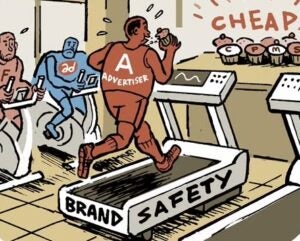
 AppNexus has banned right-wing publisher Breitbart from selling on its exchange for violating its policy on hate speech – an order endorsed by CEO Brian O’Kelley, and depending on who you ask, also instigated by him. The ban was first reported by Bloomberg.
According to an internal source, at some point last week O’Kelley demanded that his ad quality team find a way to boot Breitbart from the AppNexus exchange.
But Josh Zeitz, AppNexus’ VP of corporate communications, disputed that version of events, citing several inbound complaints about Breitbart. He acknowledged it was O’Kelley who “made the final decision.”
One thing is clear: The staff and leadership at New York-based AppNexus took the news of Donald Trump’s victory hard. On the day after the election, O’Kelley sent a company-wide email to say that he was disappointed in the result and calling for AppNexus employees to band together in support of marginalized communities. A series of open forums were also organized by the AppNexus diversity team following the election to help staff digest and discuss the unexpected results.
Technology companies generally steer clear of taking political stances in enforcing their platform policies, since doing so comes with business risks. Concerns about left-leaning bias can actually lead companies to err on the side of neutrality, as may have happened this month when Facebook declined to take action against fake right-wing news on its platform until after the election was over.
In AppNexus’ case, the company insists that its decision was a simple matter of compliance, rather than a case of hating the hater.

“We always try to maintain the integrity and quality of our marketplace and if we see inventory that violates that, we turn it off. But we don’t turn off a newspaper because of political ideology,” Zeitz said. “If people, either internally or externally, bring to our attention the possibility that something in our marketplace violates our rules, whether that’s technical, creative or content specific, we will take a look. We have an obligation to.”
Emails shared with AdExchanger by AppNexus appear to show O’Kelley treading carefully, requesting that his team clearly demonstrate hate speech from Breitbart rather than basing the argument for removal on content with a merely objectionable tone or on personal political belief.
Breitbart, which enthusiastically supported Donald Trump throughout his campaign, courts controversy with its far-right stances and what some consider racist content. The site’s former executive chairman, Stephen Bannon, was tapped by Trump for a key White House post on Nov. 13.
It’s worth noting that AppNexus and Breitbart were not direct partners, and Breitbart was never a client. Its inventory was exposed to buyers on the platform through third-party SSPs or networks that work with Breitbart and hook into AppNexus.
A human team at AppNexus first started looking into Breitbart about a week ago and shortly thereafter the company added the domain to its blacklist for disseminating what it considers to be inappropriate content, defined by AppNexus as sites that include “porn, piracy, hate speech, etc.”
Conduct a search for any derogatory and discriminatory word you can think of for women, minorities or homosexuals on Breitbart’s internal search engine and you’ll get numerous hits.
It’s unclear how the ban will impact Breitbart’s monetization. AppNexus is an ad tech unicorn and second only to Google in terms of scale, but the right-wing publisher isn’t hurting for ad tags.
 A Ghostery scan of breitbart.com brought up 127 trackers, 109 of which are ad-related, and Breitbart inventory is still available through numerous exchanges, including Google AdSense, OpenX, PubMatic and Rubicon. (As of Wednesday morning, Ghostery was still showing AppNexus listed as one of the many ad trackers on Breitbart.com.)
AppNexus, which launched an inventory quality initiative last year after the platform caught flak for letting in too much fraudulent traffic, doesn’t often kick sites out of its exchange for hate speech offenses. Off the top of his head, Zeitz said he couldn’t recall the last time that had happened. Sites are usually removed for far more prosaic infractions, he said.
“Most of the things people get flagged for are pretty mundane and technical, like low-quality ad units, bad viewability or something that’s promoting clickbait or looks like a content farm,” he said. “There are lots of completely uninteresting reasons for why something gets turned off. This one happens to be in the news right now.”
And, at the moment, so is AppNexus.
Meanwhile, other exchange platforms seem less willing to tiptoe into the waters of political speech.
A PubMatic spokesperson told AdExchanger that as a marketing tech platform it “does not police editorial content, with the caveat that illegal content is banned, i.e., pirated material, as is that of a violent or pornographic nature.”
Google’s content guidelines go a bit further, reserving the right to disable ad serving on any content that is adult, violent or that advocates racial intolerance. Other prohibited categories include recreational drug use, alcohol, tobacco, hacking and weapons. A Google spokesperson said the company is purposely a little vague on the details about how it enforces its content policy so offending sites can’t use that information to their advantage.
Although neither PubMatic nor OpenX has a contractual relationship with Breitbart, they do serve ads on Breitbart via an ad network or work with customers that have their own partnership with the site.
The AppNexus ban will stay in place so long as Breitbart continues to use offensive language and foment aggression against particular demographic groups, but the site isn’t barred forever.
“If they become compliant, we can turn them on again,” Zeitz said.
It’s difficult to imagine that happening.
Breitbart did not reply to a request for comment.
This is not the first time in recent memory that AppNexus strong-armed a company off its exchange. In September, AppNexus severed ties with ComboTag, an Israeli startup that sources buyers for the Adblock Plus Acceptable Ads program.
With additional reporting by Zach Rodgers. Updated on 11/23/16 at 4:52 p.m. to reflect mention of the emails shared by AppNexus with AdExchanger.