

Two multibillion-dollar acquisitions and one Justice Department lawsuit later, AT&T’s advertising and analytics unit finally has a name: Xandr.
AT&T revealed the brand at its Relevance Conference in Santa Barbara, Calif., Tuesday, a debutante ball for the new unit that gathered 300 top advertising and media executives at the lavish Ritz-Carlton Bacara. The name pays homage to the telco’s founder, Alexander Graham Bell, and the heritage of innovation he established back in 1877.
AT&T also said Xandr has inked deals with Altice USA and Frontier Communications to aggregate and sell their addressable TV inventory. The deals mark the beginning of AT&T’s vision for Xandr to offer media from other content owners enriched with AT&T data.
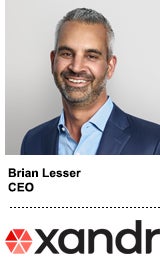
AT&T hopes Xandr can revolutionize the ad business by making advertising relevant to consumers, profitable for media companies and accountable and efficient for advertisers, said CEO Brian Lesser in a press briefing.
“The modern media company [has] everything to do with the combination of content, distribution, data and technology,” he said. “AT&T alone has the components to solve this problem.”
Xandr will combine data on AT&T’s 170 million subscribers across mobile, broadband and OTT with WarnerMedia’s vast library of content to deliver targeted ads to consumers. That combination will enrich AT&T’s data over time and position the company to better deliver its core telecom product to consumers, Lesser said.

But Xandr’s real vision is much grander: to launch a marketplace for all media owners where advertisers can bring their own data, augment it with AT&T data and run measurement and attribution models based on their own standards.
“We want to give data back to our clients so they don’t have to trust us that it works,” Lesser said. “They can ingest the data, model it themselves and make sure it works on their standards.”
 AppNexus, which AT&T purchased for a reported $1.6 billion in June, will be central to Xandr’s goal. In addition to continuing to build its core programmatic marketplace, AppNexus will build a platform that makes linear TV buying more automated and data-driven while taking AT&T’s $2 billion addressable business fully programmatic, Lesser said.
“Once an advertiser understands the audience, they can reach them in all of these channels with precision and performance, but also have the ability to measure the effects,” he said.
Xandr will also reimagine TV ad creative so that it’s less interruptive for consumers and more measurable for advertisers. Rather than stopping content to insert a 30-second spot, for example, there may be a branded icon on the screen viewers can click on to get more information on their mobile phones, Lesser said.
“Many have tried before and failed at developing new formats for advertising,” he said. “Unless you can insert the format into the content and deliver it through technology to the precise audience who wants to see it, you can fail.”
Hold up
Despite a shiny new brand name, Xandr faces a few challenges. First will be getting other media companies – especially those that are competitive with WarnerMedia’s properties – to put their premium inventory on its network.
Regulation could also pose a challenge. While Lesser said advertisers can do their own attribution with anonymized AT&T subscriber data, pending state-level regulation could make it difficult for them to do so at scale outside of AT&T’s walls.
“We would prefer if there was legislation around how data is used,” Lesser said, “but we want it to be federal, not on a state-by-state basis, and we’re working collaboratively to do that.”
But with the full support of AT&T top dog Randall Stephenson and a stable of some of the most premium content behind it, Xandr – and Lesser – may have a fighting chance.
“I thought I had an opportunity to change the market at GroupM,” Lesser said. “But after speaking with Randall, I knew I had a better opportunity to change the market at AT&T.”







