

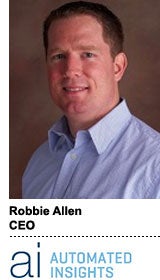
 Ever since his company, Automated Insights, announced a partnership with the Associated Press (AP), CEO and founder Robbie Allen says it’s been a bit of a whirlwind.
The idea that his Durham, N.C., firm’s technology could automate what reporters do with the appropriate data inputs clearly has larger implications. As The Washington Post and Poynter, among others, have previously reported, Automated Insights technology can produce a 150- to 350-word article without any human involvement.
For AP, this means the data deluge from public company earnings reports, for example, could be harnessed into a quick readable format.
Not only is the AP a client, but it’s also an investor and participated in Automated Insights’ (AI) latest $6.5 million round of financing, along with Osage Capital, AOL founder Steve Case and Samsung Ventures. Not bad for a company with just 35 employees.
With both a computer science and writing background informed by his days at Cisco Systems and a degree from MIT, Allen looked to marry the two disciplines based on the notion that certain types of quantitative analysis could be automated and ascribe what’s interesting about data sets.
Initially it was finance, real estate and sports data – even today, Automated Insights plays a role in delivering fantasy sports news through Yahoo. The latest data sets have to do with business such as the application with AP’s business reporting.
How about marketing and advertising? AdExchanger spoke to Allen.

AdExchanger: So how could your company’s technology relate to advertising and marketing? Any ideas yet?
ROBBIE ALLEN: I think it’s something that we’re just now starting to explore with some major brands. The whole notion of “native advertising” has become very popular in the last year. What we can drive is a certain level of personalization that’s never really been done before in advertising.
If you ask me, “What industries do we cover? What industry is our focus?”, I would tell you we don’t really have an industry focus. We have a horizontal focus that I call “personalization.”
What I mean by that is we create a piece of content that’s intended for one person to read, or maybe it’s a small number of people.
I like to say, “We turn the traditional content creation model on its head.” The traditional model is, “I’m going to create a piece of content, whether it’s an article or even an ad and the intent is to have lots of people look at that and read it.” Our model is the inverse. We create a piece of content that’s intended for only one person to read, but we’ll create millions of those so that every person has their own unique copy.
If you think about that in terms of advertising, what it could mean is a much more personalized experience – a holy grail of the advertising world.
Hypothetically, Fidelity is a brand for which we could help create personalized advertising messages. We could integrate in real-time content about how the market’s performing today, for example.
How is your company’s tech different – or is it related – to something called “dynamic creative optimization,” which in some ways speaks to this ability to create a one-to-one communication?
It’s our ability to create compelling narrative. Let’s take weather data. Most of the solutions out there are going to be fairly canned in terms of how they’re describing things or what they’re describing. They would be able to say, “It’s been raining for three days now. You may want to go visit JCPenney.com to look at the best deals on umbrellas.” But we factor in personalization with other bits of information to drive a much more personalized message. You can only do that if it’s truly automated. Even if you have complex templating systems there’s only so much variability you can drive.
How far are you away from taking the data, the success metrics, of an ad campaign and turning it into a capability for creating successful ad campaigns – maybe not only with the creative and what it says, but with some intelligence behind it in terms of how to target people?
It’s the bleeding edge for us in terms of advertising and what’s possible. We’re in the early stages of talking with some of the largest brands and media companies that have lots of advertising that they have to fill. We’re trying to figure out what’s the right way to name it, such as “programmatic native advertising” – but that shouldn’t be confused with “programmatic advertising.”
Now, in order for our stuff to work there needs to be some sort of data source for us to drive off of. What we’re finding is, increasingly, that’s not a roadblock because companies are doing a much better job of collecting and storing data.
Getting a bit more into the weeds of Automated Insights technology, are there any limitations right now – different languages?
There’s a couple things. One is just in terms of what kind of tone can you use? That’s a common question that we get. Does the content sound robotic or how does that work? I think a great example of the difference in comparing one of our AP earnings recaps with one of our Yahoo fantasy football recaps. Yahoo this year said that they wanted us to make the fantasy football recaps even more snarky than they were last year. They wanted it very humorous. If you look at the result, it reads totally different than the AP earnings reports, which are more straight to the point.
In regards to languages, we’re talking to several companies now about adopting what we’re doing with English for other languages such as French, Spanish, German and even Korean. There’s no reason why we can’t do this exact same thing in other languages.
In terms of where we’re going to be in five years in the world of media, what is the impact you can see from technology like your company’s?
I think in five years, with news like our AP partnership, it will seem obvious and even mundane. There won’t be this fascination that we have today on, “Wow. You mean you’re going to have software automatically create some portion of our news content?”
I’m not going to say it’s the primary news-creation mechanism, but I will say that it will be pervasive. In fact, I think what you’ll find is it will be commonplace for reporters to have software like ours – our Wordsmith platform.
Follow Robbie Allen (@RobbieAllen), Automated Insights(@AInsights) and AdExchanger (@adexchanger) on Twitter.








