

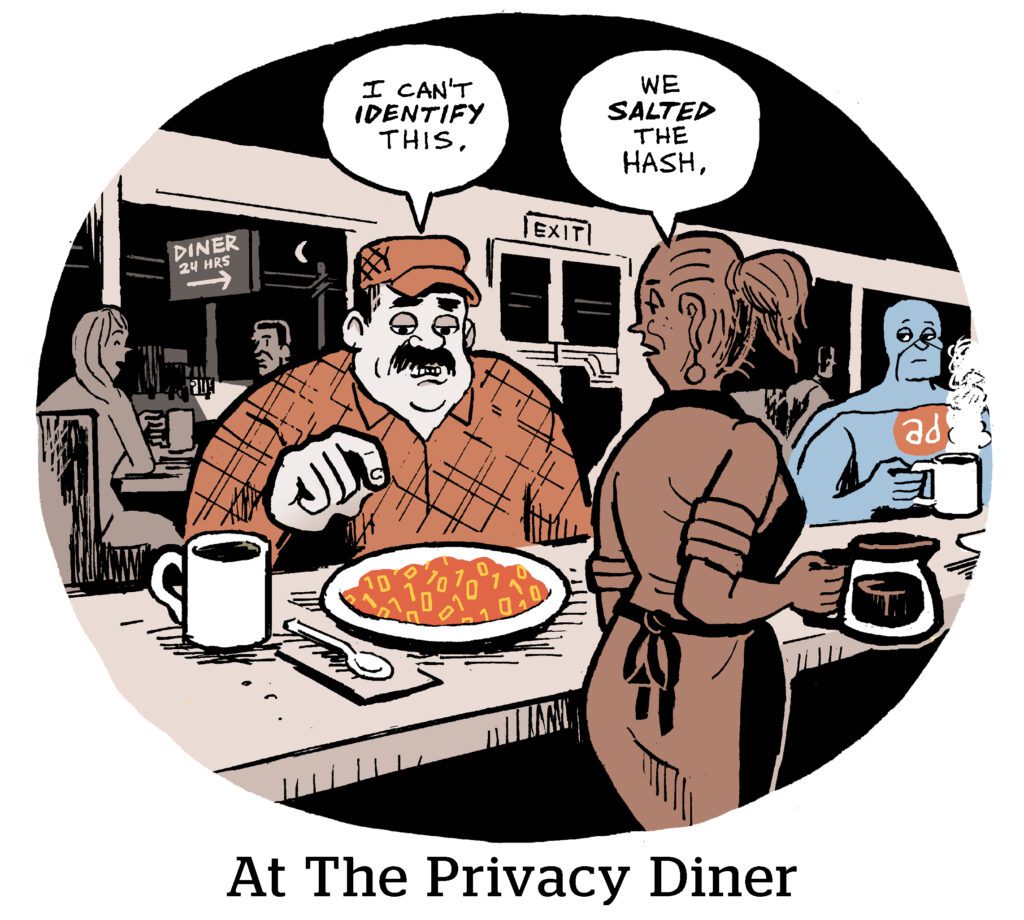
Advertisers are always looking for easy buttons.
On Thursday, customer data platform Hightouch released one with the launch of ID Express, a solution that converts email addresses and phone numbers into Unified ID 2.0 (UID2) identifiers with just a few clicks.
The hashed identifiers are used to create privacy-safe addressable audiences that advertisers can choose to target or suppress through The Trade Desk.

The data pipeline
Hightouch acts as a conduit between a brand’s data warehouse and platforms such as TTD, sort of like a data pipeline, said Ian Maier, a go-to-market and product leader at Hightouch.
Although Hightouch is a customer data platform, it doesn’t actually store any customer’s data. Rather than a data repository, Hightouch is what’s known as a composable CDP, meaning it serves as “connective tissue” between a data warehouse and ad platforms, Maier said.
ID Express pulls the ingredients that go into a UID2 – emails and phone numbers – from systems like Snowflake or Databricks, replaces the raw information with anonymized tokens and pipes that converted data into TTD and other platforms.
The identifiers are derived from log-ins and authentications across the open internet.
When someone logs into their Spotify or Hulu account, for instance, the publisher can send the associated UID2 to The Trade Desk in the bidstream and then personalize advertising to that individual user, said Jaime Nash, director of product marketing at TTD.
Hashing out the details
But for a process that sounds so technically complex, the conversion from email address or phone number to UID2 is rather simple from the marketer’s perspective.
Hightouch clients using ID Express are a mix of marketers and media sellers, including streaming platforms and retail media networks, Maier noted.
Advertisers select what they want to use UID2s for, such as tracking offline conversion events, for example, or creating a first-party data segment. They then provide hashed email or hashed phone number fields from their data warehouse to Hightouch.
If the data isn’t already hashed for whatever reason, Hightouch automatically detects that and hashes it for them.
From there, Hightouch securely converts the identifiers to UID2s and sends them to The Trade Desk where they are made available to brands for targeting and measurement.
UID-(emocratization)
Since email addresses and phone numbers are so often used in exchange for access to content – and people don’t change them very often – they have “long standing durability,” said Nash.
This longevity helps to “balance” the customer experience with the needs of advertisers, she said, by accurately tracking past purchases and ad exposure.
For instance, UID2s can help with frequency management, making sure users aren’t bombarded with the same ad on the same platform over and over. They can also improve personalization. If, for example, a sports apparel brand sees that someone in their target audience has already bought leggings from them, it might make sense to advertise a matching sports bra, Nash said.
In the past, brands often saw UID2 implementation as too costly and technically challenging to implement, requiring custom code or complex workflows, which slowed adoption.
The purpose of ID Express is to remove the technical complications, Maier said, but also to make deploying UIDs less cost prohibitive. Hightouch now includes ID Express as part of its core CDP offering.
“[UID2] is a free and open-source solution,” said Maier. “We think the same should be true in ours.”








