

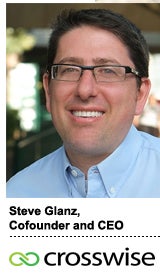
 Multiscreen tracking company Crosswise, which on Thursday launched its cross-device identification solution, doesn’t care about buying media.
It doesn’t care about creating segments. Basically, Crosswise CEO and co-founder Steve Glanz doesn’t care if you’re a man or a woman, how old you are or where you live — at least not as isolated data points.
“We’re not creating profiles of users, we’re looking for connections between data points,” Glanz said. “We’re trying to solve the problem of being able to identify users across devices employing a statistical or probabilistic solution.”
While that might ring a bell for anyone familiar with cross-device ad tech companies like Tapad or Drawbridge, Glanz said Crosswise’s product differentiates since it’s a “data-only” solution that isn’t interested in direct agency or brand relationships.
Glanz said Crosswise competitors are both technology providers and perform media services, creating a conflict. Crosswise, which has raised $2 million from several VC sources since its August 2013 founding, is by contrast a pure-play technology company. It hands the fruits of its data tracking over to demand-side platforms (DSPs), which then work with agencies and brands to buy the right media.
“Tapad and Drawbridge are great companies, but they’re also basically competing with every DSP and retargeting company,” he said. “They license their platform to ad tech companies and also try to sell direct campaigns to agencies and advertisers at the same time.”

Glanz recognizes that Crosswise is at a slight disadvantage, considering how established the other cross-device players already are in the space, but he says the timing couldn’t be helped.
“We thought of this idea last summer, we founded the company, and then we spent the initial months raising the money and building the technology,” he said. “Do I wish we were three months earlier? That would’ve been great, but it takes time to build something like this.”
Also noteworthy is Crosswise’s newly announced relationship with LiveRamp, which was recently purchased by Acxiom. The data onboarding company will be working with Crosswise to create more robust statistical models, and existing LiveRamp clients will be able to automatically integrate with Crosswise’s data service.
“A big focus for LiveRamp has been on being able to move data between different marketing applications,” Glanz said. “If a brand onboards segments with LiveRamp on the web, they can use the Crosswise technology to do audience extension.”
It all means Crosswise is very much behind-the-scenes, but Glanz says he’s cool with that.
“There are a lot of brands that have never heard of us, and that’s fine,” he said. “We’re providing our service to other ad tech companies.”
ADEXCHANGER: Can you explain in a bit more detail how Crosswise does its thing?
STEVE GLANZ: We gather massive amounts of data, all not personally identifiable, related to things like location, IP address, interests, the apps people use, etc. About 30 data points in all. Then we look for patterns in that data to indicate that this PC and this phone must be the same person based on looking at the behaviors on those devices over time.
How do you do that without PII?
We look at the data over enough time to come to a highly probabilistic conclusion that those devices must be the same person. The test is taking deterministic data, where we do know for sure, and using it to test our statistical accuracy. It’s based on machine learning and statistics, so we don’t know for sure. But if we see 10 devices coming out of the same IP address every night in Long Island, it’s pretty easy to figure out that’s probably a home. And then if we see two of those 10 devices traveling together every day into Manhattan, we know they probably belong to the same person. And then we look at the types of apps that person has and the domains that user visits. Of course, that’s a somewhat simple example. Something like the dorms at NYU would be much more complicated. But that’s why we have data scientists.
Are you SaaS?
We license our technology to other ad tech companies like ad servers, DSPs, exchanges, etc. We provide those companies with an identity solution and they can then go out and use that data as they see fit in their business. It’s completely self-service. The product is just data. Our customers call our API with a user and we get back to them with that user’s other devices. So, I guess you could say that we’re more platform-as-a-service.
Do you have access to any first-party data?
None of it really gets to the level of first-party. We’re making inferences on different data points. But sometimes something totally unexpected ends up being a key to identity. Maybe, I don’t know, people who visit cnn.com on the web also like playing Angry Birds. That’s something you’d never assume to be true, but the data tells us everything. But you need a large set of validation data and learnings to make these kinds of connections. It’s all about the data.








