

 If data is currency, then it’s no wonder most companies lock it in a safe (unless you’re Sony Pictures Entertainment, in which case you just put it on a Word document somewhere).
But this can be a tremendous point of frustration for brands that want to use the data housed by the big dogs of ad tech – Facebook, Google and Amazon – to optimize their marketing beyond those relatively closed-off portals.
Because it’s unlikely these already-existing walls will soon crumble, AOL has an opportunity to push an open platform vision to differentiate.
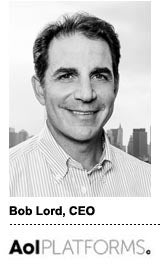
Walled gardens send the ad tech industry backward, said AOL Platforms CEO Bob Lord during a programmatic forum AOL hosted at its headquarters Tuesday. As a proof point, he noted that about 50% of brands it works with will likely own their own data-management platform.
“We’re going toward an open stack, an open data strategy,” he said. “We will allow advertisers to import data into our platform and activate that against media, and we’ll share that data with our partners to activate in their channels and put in their CRM.”

So in AOL’s vision for its open garden, will all data be extractable or will there still be some patches of lawn where clients need to keep off? Lord emphasized that all personally identifiable information will of course be off limits, nor will client data mix.
“But there are behavioral trends that we can pick off and share with the CRM system to make the targeting more effective,” he said. “If someone is shopping for an Audi and they have a lease with Mercedes, that’s an important piece of information for Mercedes to know. We can then target that customer in a different way than if they were part of the general population.”
It’s not clear whether AOL has been more or less successful than its peers at getting marketers to share data with it.
“Advertisers need to work with companies they have a deep trust with and a track record,” said Doug Boccia, SVP of Advertising.com. “We work with a number of third-party data providers, so hopefully an advertiser will have comfort bringing their data onto our platform.”
Certainly Facebook is going through a similar persuasion game with its recently rearchitected ad server, Atlas. Though in the social network’s case, the flow of data only goes one way: straight into Facebook.
Avoiding The Tech Tax In 2015
AOL’s messaging around openness isn’t confined to its data philosophy. The company is trying to extend that ideal into its technological platform as well.
In March, the company unified its various programmatic products into a stack called ONE. For the vendor, the benefits are obvious: It can provide every major function a client needs.
And Lord also argued that investing in a stack can help marketers avoid the “tech tax” – that is, the excess costs one accrues when piecing together multiple point solutions. “In the last 18-24 months, [the tech tax] has gotten worse, not better,” he said. “I think the ultimate consequence will be consolidation.”
But clients have real concerns around vendor lock-in – it’s easier to replace a point solution than a suite. They’re also concerned they’ll have to ward off constant attempts from aggressive vendor sales staff to purchase more product.
And AOL’s purchase of attribution tech company Convertro certainly raised eyebrows around whether it would still provide neutral measurement.
AOL is no doubt wary of these concerns, and Lord emphasized it’s working toward building a modular stack, one that doesn’t have to be purchased end to end. AOL, he said, plans on creating open APIs so individual components of the AOL marketing stack can plug into other vendors’ solutions.
Of course, the stack might simply function better disaggregated. As with most suites built through acquisition, integration is a challenge.
AOL Platforms’ former VP of technology operations, Charles Butler (now Annalect’s CTO), characterized ONE as “a handful of very dissimilar vertical technologies. ONE is trying to create a tiered-level unification that presents itself as one to the outside, but will actually be different technological venues underneath. In a couple of years from now, it should ideally be far more integrated.”
Video, TV And Content Collide
One of AOL’s most recent acquisitions, publisher video marketplace Vidible, was intended to ramp up its sell-side technology capabilities, said Lord.
“We built a lot of tools to … monetize the daylight out of publisher content and sites, and all we’re doing is [plugging into AOL’s] branded ecosystem and adding more technology to the stack,” said Michael Hyman, CEO of Vidible. “Vidible focused on making it incredibly easy to get publishers on board [in a programmatic marketplace] and drive ROI.”
Although the deal is not yet finalized, Lord expects Vidible’s first point of merger to be the video syndication platform 5min Media, followed by various other publisher solutions. For example, content personalization tool Gravity, which AOL acquired last January, along with rich media platform Pictela, could provide the creative component for Vidible’s syndication efforts.
These integrations feed into AOL’s goal in 2015 to tackle data-driven creative. “We’ve got placement nailed,” claimed Lord. “We know contextually where someone is, but what we haven’t nailed yet is the multiple creative we can serve up. You see about 30% uplift when you change the creative with the placement.”
Along with strengthening publisher creative, the Vidible buy fits into AOL’s broader acquisition strategy around digital video and TV, such as programmatic video marketplace Adap.tv and TV ad-targeting platform PrecisionDemand.
AOL Platforms is experimenting with linear TV campaigns in the scatter market (in non-broadcast speak, scatter is inventory put up for sale closer to the air date as opposed to being sold in the upfront, which, thus, commands a higher price), as well as in Australia, where cable group Multi Channel Network struck a private marketplace deal with Adap.tv.
At present, there are more than 52 campaigns incorporating linear TV inventory running now through Adap.tv, said Lord.
“In 2015, more people will use automated buying for linear TV,” he added, but noted the inherent lag that exists between the upfront buy and campaign reporting. And, of course, the lack of direct access to premium cable inventory.
“We have predictive models through Convertro and PrecisionDemand, which give you a simulation [on what to buy] based on what you bought in the past,” Lord said. “We’re pretty excited about TV.”
Ryan Joe contributed.









