


Ever click on an ad by mistake? You and the rest of internet-connected humanity.
On Tuesday, Facebook said it’s going to stop counting those errant clicks in its reporting for ads served through Audience Network and start barring publishers from including clickable white space in the background of their native ads.
Beginning next week, if a user bounces in under two seconds after clicking on an ad, Facebook will remove it from the click tally, meaning that the advertiser doesn’t pay and the publisher doesn’t get credit.
When users immediately return to whatever they were doing before they clicked on an ad, it’s a good indicator that the engagement has little or no value and that “they didn’t mean to click in the first place,” said Brett Vogel, a product marketing manager at Facebook.
Facebook is analyzing whether clicks lead to or influence business outcomes like a sale or an app download.
“Those types of outcomes very, very rarely come from click bounce-backs that are under two seconds,” Vogel said.
Apps are particularly fertile ground for accidental clicks.

Users in the throes of gameplay or rapidly scrolling through a news app are liable to tap on an ad by mistake if it pops up in the middle of the game or if the placement is jammed in too snugly beside an important UI element – like the “home” button, for example.
These “unintentional clicks are sometimes profitable for publishers, but they typically don’t deliver value for their advertisers or for customers,” Vogel said.
Over time, advertisers are likely to stop spending with publishers that look good on the surface but don’t deliver real results.
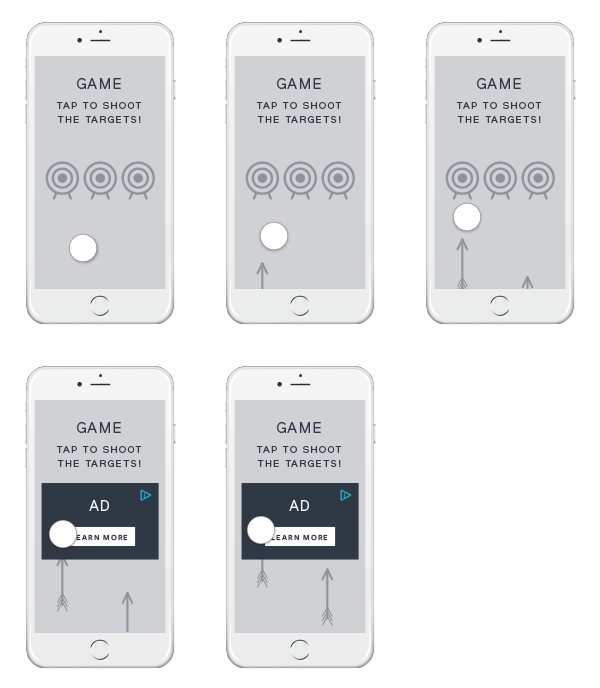 A lot of the responsibility for eliminating mistaken clicks lies with the publisher. Surfacing ads at the same moment a user is trying to complete another action, for example, is an invitation for bounce-backs.
But it’s also the publisher’s job not to develop units, especially native units, that can lead to unintentional clicks.
“Publishers often have a lot of discretion in terms of how native ads render,” Vogel said.
To that end, Facebook released a new policy in conjunction with its move to discount inadvertant clicks that cautions publishers to limit the amount of clickable white space they include in their native ads, as another way to help cut down on accidental clicking.
Although Facebook claims that most of the publishers in Audience Network won’t be affected by the removal of accidental clicks, primarily just those with placements near UI elements, erroneous clicking is a widespread industry problem.
According to a report released by location-based shopping app Retale last year, 60% of all mobile banner ad clicks happen by accident.
Facebook’s effort to clean up click counts on Audience Network is in line with its general crackdown on crap.
In May, Facebook started using AI to disincentivize clickbaiters by deprioritizing links that direct to sites with too many ads, disruptive units and questionable content. Last week, Facebook said it would start ranking slow-loading links lower in people’s news feeds (although cynics might see that as a ploy to get more publishers on board with Instant Articles).
In addition to its war on accidental clicks, Facebook also introduced two metrics on Tuesday – gross impressions and auto-refresh impressions – as part of its recent self-proclaimed push to provide advertisers with more transparency.
Gross impressions will give visibility into the total number of impressions, both billable and nonbillable, that advertisers receive on Facebook. Previously, Facebook only surfaced total billable impressions.
Refresh impressions will give advertisers a more granular view into how many impressions are generated from right-hand side ads in the news feed on desktop. Ads that appear to the right of the news feed are automatically refreshed when users take actions that could indicate interest, like scrolling or hovering their cursor over the ad.
“Both updates are small,” Vogel said, “but they help ensure that businesses have the transparency they’re seeking into ad delivery on Facebook.”








