

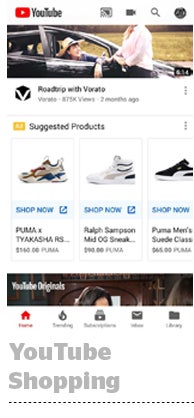
Google is taking advantage of all the product discovery happening on YouTube.
The company said on Tuesday that advertisers buying Shopping Ads can extend their campaigns so those ads show up on YouTube’s home page and search feed. Google first let marketers use its search data to inform YouTube targeting back in 2017.
User behavior, however, determines what sort of ad unit consumers see on YouTube. People who searched for a specific product will get relevant offers, while people who were browsing without that strong intent will see Discovery ads, which are based on their interests or past shopping behaviors, said Nicky Rettke, director of product management for YouTube Ads. Both ad units link out to product detail pages on advertisers’ websites.
These Shopping Ads are a new direct response unit for YouTube, where people increasingly turn to discover new products. Marketers can bring their own custom audience segments or use Google’s behavioral data to find YouTube viewers who recently searched for their product or a similar one.
Brands can now also conquest on YouTube, as long as their product is relevant to the search query, Rettke said.

So far, Puma, Urban Outfitters and Nectar have used the ads on YouTube. Urban Outfitters saw a 241% lift in click-through rates across campaigns, increasing sales 186%. Fifty-two percent of that traffic came from new customers. Nectar, meanwhile, saw an 8% lift in sales while lowering customer acquisition costs by 70% compared to paid social campaigns.
“We want to drive incremental conversion volume by expanding reach onto YouTube so that they’re coming at a similar cost per conversion as you would find on search,” Rettke said.
In addition to Google’s extension of shopping ads, the company is also letting advertisers deep link on TrueView for action ad units, its direct-response pre-roll and mid-roll video ad units that feature prominent links and calls to action. The new deep linking capability allows brands and retailers to point back to specific pages related to the ad, like a product detail page, as opposed to a general website or homepage.
“It’s part of a broader strategy for making YouTube overall more shoppable,” Rettke said. “By having a variety of formats, we can have more diversity in advertisers running, and we can really choose the right product for the user in that moment.”
Google’s ultimate goal is to capture more shopping budgets, as competition from Adobe, Amazon, Facebook and Instagram heat up. The company launched a suite of ecommerce ad products at Google Marketing Live in May, as well as a vertical-specific offering for retailers on Google Cloud in April.






