

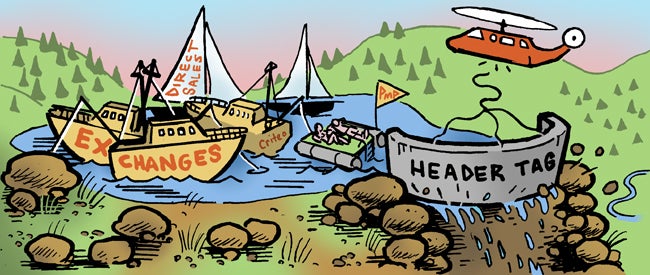
Header bidding is changing the industry and creating a new set of winners and losers.
After a dismal earnings call, Rubicon Project’s stock fell 32% and lost $200 million in value Wednesday.
Rubicon CEO Frank Addante said the company failed to respond quickly to the header bidding trend, sending its desktop revenue into decline. Although other parts of its business are under pressure, the stock’s fall was “primarily related to header bidding,” said Kerry Rice, senior equity analyst at Needham & Company.
Rubicon isn’t alone in seeing its position in jeopardy because of header bidding.
By allowing other players to bid programmatically before the ad server, header bidding is dismantling the hooks Rubicon created within Google’s DFP ad server to prioritize access. Google’s Ad Exchange must also pay more to win impressions. Criteo, once alone in header bidding, also faces more pricing pressure.
“We believe some high-value users may become more pricy as a result of these changes in auction pricing,” said Criteo CEO Eric Eichmann during his company’s earnings call on Wednesday.
Criteo, an early adopter to header bidding, relies on direct publisher deals for about 35% of its revenue. But header bidding awards the impression to the highest bidder, so smaller SSPs without strong publisher contracts can grab impressions that would have been reserved previously for big buyers like Criteo and Rubicon.
“Businesses that are built to purchase inventory at the lowest price points possible – basically all the cookie bombers – are getting squeezed out of inventory,”

said Jonathan Mendez, CEO of Yieldbot. That category includes SSPs, DSPs and retargeters, he said.
Sources say Google’s comparatively slow growth in the “Google Network Member Websites” category – the category grew just 3% in Q2, while other segment revenues saw double-digit growth – likely reflects pressure from header bidding, as publishers using the tech have seen dramatic decreases in the amount of impressions that go to Google and its primary SSP, often Rubicon.
Google disputed that analysis. It said its programmatic business is on fire and seeing significant growth.
But on the ground, publishers and SSPs are seeing dramatic reallocations of inventory. “Publishers that had a 60% or 70% reliance on Google pre-header bidding have seen that cut in half,” noted Jason Fairchild, co-founder and CRO of OpenX.
Rubicon President Greg Raifman said both his company and Google are experiencing impression “leakage,” which he blamed on “smaller competitors” that saw an opening.
Those companies – not all of them small – include OpenX, AppNexus, Index Exchange, and Yieldbot, all of whom told AdExchanger their companies have grown because of header bidding. Yieldbot reported $35 million in funding Wednesday, and profitability as well.
OpenX said header bidding adoption grew 300% over the past year, and that it drove 80% of the company’s overall growth. “We don’t see headwinds. We see a strong industry current,” Fairchild said.
Index Exchange now derives 80% of its overall revenue from header bidding, according to CEO Andrew Casale, the result of a hard push into header bidding over the past couple of years. Rubicon Project reported 13% of its managed revenue came from header bidding in June, up from less than 1% in January.
And header bidding was an “important driver of growth in our publisher technology business,” according to Pat McCarthy, SVP of product for the publisher tech group AppNexus.
Rubicon is struggling while other SSPs are benefiting because of its business model. It initially signed premium publishers to 18-month contracts guaranteeing that Rubicon would see most of the publishers’ impressions. Competing SSPs would get leftovers in a waterfall-style setup.
Rubicon’s strong contracts and advantageous setup made it reluctant to switch to header bidding. “Rubicon was late to the header because they fundamentally didn’t want this to happen,” said one source speaking anonymously so as not to jeopardize their company’s relationship with Rubicon.
But as Ari Paparo, CEO of Beeswax, pointed out, “Any remaining stickiness of the SSP is diminished even further by this [header bidding] tech.”
Now that header bidding partners are picking off impressions before Rubicon gets to them, it has lost its privileged position.
The other SSPs overtaking incumbent Rubicon see this as a good thing because now the best price wins, publishers earn more and buyers get programmatic access to more impressions.
“A few years ago, it was a walled garden,” Fairchild said. “And it was a more binary type of ecosystem.” Before, companies like Rubicon with the best contract won. “Now the reality is many of us will share customers in an effort to drive competition for the customer.”
Rubicon Project has said it’s playing catch-up with header bidding and plans to assume its rightful place at the end of the year. “Unfortunately that does not give investors any comfort,” Rice said. That’s one reason why the stock declined so much.
While Rubicon, Google and Criteo might adjust to this new order, the pie can only be cut in so many slices. That limit will likely lead to consolidation in the industry, as publishers settle on using five or so header tags, sources said.
With the rise of header bidding, SSPs may evolve so much they no longer resemble SSPs. To differentiate themselves, some may look to automating orders. OpenX and Rubicon Project are in that camp, for example.
Or SSPs may stop being SSPs. Casale projects that take rates will decline as SSPs look more like pipes and competition forces more fee transparency.
“I think the SSP is dead,” he said, “and every SSP is going to become an exchange.”








