

Pinterest wants to own the moment when consumers have an idea of what they want, but haven’t committed to a specific product or brand.
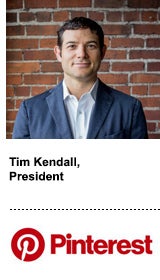
“People use Pinterest to plan their lives, from the everyday, like what am I going to cook tonight or wear to a party on Saturday, to milestones like weddings, kids’ birthday parties and anniversary celebrations,” said Pinterest President Tim Kendall.
The platform, where users can browse and curate ideas, recipes and inspiration, hit 200 million monthly active users this year, representing 40% year-on-year growth.
Retailer Target certainly hopes to capitalize on that momentum.
It’s embedding Pinterest’s visual search technology, Lens, which lets users scan physical products to generate related recommendations and ideas, into its app and website to help it better merchandize. Pinterest, which also has merchandizing partnerships with Walmart, Home Depot, Nordstrom and Niemen Marcus, will provide Target with trends and insights about its customers in return.
“It includes a large multiyear media investment from them,” Kendall said.
But Pinterest is also cozying up to verticals that might seem less adjacent to the core use of its platform. Financial services is the platform’s fastest-growing category behind retail and CPG, Kendall said; Chase, American Express, Bank of America and Visa are clients.
Part of Pinterest’s allure is data, and it’s scaling that, too. The platform expanded its targeting segments around user taste profiles from 400 to 5,000, Kendall said. Brands can juice up that targeting by bringing their CRM files to the platform.
“We have 200 million people telling us what their taste is in everything,” Kendall said.
The “vast majority” of Pinterest’s inventory is sold programmatically, Kendall said. Half of buys run through private marketplaces and half run through Pinterest’s preferred marketing partners, which include 4C, Amobee and Kenshoo.
Kendall spoke with AdExchanger.

AdExchanger: What is Pinterest’s value prop to marketers?
TIM KENDALL: [Our users] have a sense for what they want. For instance, I’m redecorating my office and I want my desk chair to look a certain way, but I don’t know who I want it from. A marketer can reach someone and interrupt them when they’re looking at pictures of their kids [on social platforms], or reach someone when they know they want a chair [on Pinterest].
How is that a different opportunity than, say, Google search?
It’s early planning without knowing. What’s the query you put in to get that chair? It’s formative. At the highest level, I want a home office.
Amazon and Google are terrific when I know exactly what I want, but there’s so much of the world left to discover because I don’t have that specificity now.
How does your data help brands maximize that opportunity?
Imagine I sell gardening supplies in New York City. Most marketing services would be able to [offer] people between 30 and 40 years old who just moved to New York City and have an interest in gardening.
We can [offer] people from 30 to 40 years old who just moved to New York City, are planning their urban garden right now and they like these three kinds of plants. They’re also are redoing their home office, looking for desks and have mid-century modern taste. Before, I probably wouldn’t be able to make that campaign pay.
How are you thinking about visual search as voice interfaces become more popular?
Voice is going to be huge. It’s taking off in the factual domain. It’s great for giving me a stock quote or a sports score. There’s no ambiguity there. There’s no interpretation.
But how is voice going to help you redecorate your home office? Alexa, tell me what my home office will look like. What are your words for describing that? That discovery input for food, home, style and beauty has to be visual. In a way, the Target deal validated that.
What’s your value to a brand that isn’t super visual, like a bank?
People planning for milestone events make choices about financial service providers. When I’m remodeling a home, I’ll get a home equity line of credit. When people get married, partners consolidate their checking accounts. That is a great time for a bank to acquire a new customer.
What about the bottom-funnel opportunities? How does Pinterest drive results?
Seventy to 80 percent of the value we create is [finding] new customers. A lot of retailers are using buyable pins and users are gradually buying more. It’s going to take time for us to figure out the right user interaction and get people acclimated to the idea of buying on Pinterest.
One of the things we learned [from] buyable pins was people need a vignette to be compelled to buy something. For example, here’s a cactus, but here’s how someone set it up on the windowsill with these other plants.
You recently launched autoplay video. How do you balance pleasing advertisers with the user experience?
We’re watching carefully the degree to which it has any negative impact. We allow people to give us feedback on ads. If a user is down voting an autoplay video ad repeatedly, we’ll make adjustments for that particular user.
Is Pinterest a walled garden?
By virtue of the specificity around our targeting, [the data we give marketers is] more detailed. We allow you to target people who are currently planning an urban garden and like [a specific] plant. We report on all of those segments. You can see our end file within all those segments.
This interview has been edited.










