

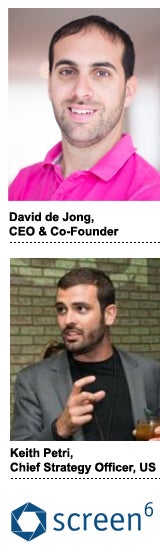
 Dutch cross-device data vendor Screen6 has been flying under the radar and avoided the Nielsen verification route like its well-known competition.
Last year, Tapad (recently acquired by Norwegian telco Telenor) and Drawbridge had the accuracy of their device graphs evaluated by Nielsen, coming in at 91.2% and 97.3%, respectively.
Screen6 CEO and co-founder David de Jong is skeptical.
“Yes, Nielsen has a huge panel, but it’s still just a panel,” de Jong said. “Taking a subset of your device graph and handing it over to Nielsen to be verified is a bit like the new Hilton in town inviting journalists to come and stay in their very best room and expecting the best review possible. I do think agencies, brands and other tech vendors are going to start seeing the bubble on this one.”
In any case, the way Screen6’s technology operates doesn’t really lend itself to a single verification score. Tapad and Drawbridge each have one primary graph to verify. Screen6 has multiple graphs – as in, as many graphs as there are clients.
Rather than clients sending their data to be matched against a master graph – which at the same time trains the graph to be smarter for the competition – Screen6 develops graphs on a client-by-client basis.
“And if they want to verify it themselves, they can,” de Jong said. “Because we give them back the whole shebang. It’s their device graph.”
It’s a matter of not “wanting to grade our own homework,” said Keith Petri, who joined Screen6 in March as US chief strategy officer after a stint as VP of strategic partnerships at IgnitionOne.
Although Screen6 hasn’t tabulated its overall preciseness across its clients’ graphs, it claims to be able to create matches for attribution purposes among its tech vendor clients after seeing a mobile web cookie just once with between 85% and 94% accuracy.
Founded in 2012, the company has seven employees in Amsterdam and a newly opened New York office, where Petri will focus on US expansion. Among its roughly 30 clients are Adform and Sizmek, which uses Screen6 to service Havas, among others. Although the company is profitable and hasn’t yet pursued funding, Petri said it’s contemplating a round to fuel growth.
AdExchanger caught up with de Jong and Petri.

AdExchanger: First off, what does all the recent M&A – Verizon/AOL, Tapad and now Crosswise, which just got snapped up by Oracle – mean for the cross-device space?
KEITH PETRI: I’d suspect new players in the space, as well as additional consolidation. It only further justifies the need for a solution across both paid media and market research. While there are still debates in regards to deterministic vs. probabilistic models, we’re observing that even some of the largest companies with expansive yet still limited deterministic data sets are finding the need to truly achieve scale by exploring probabilistic models.
You create a new device graph for each client. How does that work?
DAVID DE JONG: We receive our clients’ data every day stripped of personally identifiable information and look for patterns to connect one device to another, as well as intradevice connections, meaning between in-app and the mobile web or between mobile browsers on one device. What we don’t do is operate a media business.
PETRI: We’re purely the agnostic connective tissue for companies to leverage to build an internal identity graph.
What are your differentiators?
PETRI: We can achieve scale immediately by overlaying our methodology on top of a client’s data. That enables us to be privacy compliant as a data processor in any geo across the globe.
We also work with any unique identifier. While other vendors need to do fancy things like cookie syncing and piggybacking on pixels, for us UID is just one identifier. It can even be an internal identifier provided by the client. As a result, we can work across connected TV and even connected cars. We literally have Teslas in our data through QT, the Tesla browser.
What’s your methodology?
PETRI: Other platforms rely on IP householding and then they differentiate with whatever their secret sauce is. Although we do leverage IP, everything we do is based on pattern matching. We look at the recency and frequency of associations between UIDs, as well as other attributes, and use a scoring algorithm to whittle down the individual associations.
Are you probabilistic or deterministic?
DE JONG: Our solution is purely probabilistic. We look for patterns in the data and process our clients’ data strictly in silos. Although other companies do pattern matching, they always rely on a base of deterministic data, and that can create some issues.
What sort of issues?
DE JONG: For one, data ownership. Many of the data sources and advertising companies out there do not actually own their data, and if you’re building a graph on top of data you’re getting from second- or third-party sources that also don’t own the data, that can create all sorts of conflicts. I envision that at some point in the near future it’s going to become much tougher to enable the creation of cross-device graphs in certain geographic zones if you don’t have clear data ownership rights.
PETRI: We also don’t leverage any of data that comes out of one client’s graph to inform another and there is no overarching graph with data from multiple clients being licensed to the competition. Basically, we charge clients for the service of overlaying our methodology over their data and for their sole benefit.
How do you handle privacy?
DE JONG: We’re based in Amsterdam, and Europe is known to be very strict in terms of privacy legislation and what is considered to be PII, so our process does not rely on any deterministic data.
We also do distinct data processing and storage between regions because we have quite a lot of clients that operate globally, mainly across North America, Europe and APAC.
There is also no connection between us and the consumer, just between us and the tech vendor or client. We receive data and we send it back, but we do not track. There is no such thing as a Screen6 cookie or JavaScript. Finally, we don’t own the source data. The client will always retain ownership of that.








