 Big Tech can’t catch a break in DC … actually, scratch that.
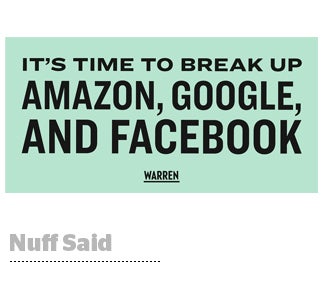
If Sen. Elizabeth Warren, D-MA, is elected to the White House in 2020, she’s got a plan to break up Amazon, Google, Facebook and Apple. And her proposal specifically targets Google’s ad platform business.
On Friday, the Democratic presidential candidate laid out how her administration would rein in companies that she says have “too much power over our economy, our society and our democracy” and to promote competition in the process.
In Warren’s view, regulators have been far too laissez faire when it comes to mergers in the digital market.
Facebook, for example, snapped up potential competitors when it acquired Instagram and WhatsApp; Amazon wielded its immense market power to force competitors like Diapers.com to sell at a discounted rate; and Google faced no opposition when it bought DoubleClick, which is probably one of the most lucrative ad tech acquisitions of all time.
The government, in Warren’s view, waved these transactions through rather than blocking them for their “negative long-term effects on competition and innovation.”

“Weak antitrust enforcement has led to a dramatic reduction in competition and innovation in the tech sector,” Warren wrote. “With fewer competitors entering the market, the big tech companies do not have to compete as aggressively in key areas like protecting our privacy.”
So, how does Warren’s proposal propose to restore competition to the tech sector?
The first step would be to pass legislation that designates tech platforms with $25 billion or more in global turnover and that offer a public-facing online marketplace, exchange or platform for connecting third parties as “platform utilities.”
These newly labeled entities would be prohibited from both owning the platform utility – say Google’s ad exchange – and participating on the platform. In other words, DoubleClick would have to be split off from the larger Google platform. In Amazon’s case, that would mean spinning of Amazon Basics from the marketplace business.
Platform utilities would not be allowed to transfer or share data with third parties.
From there, Warren would appoint regulators who are “committed to reversing illegal and anticompetitive tech mergers.” She even ticked off a few offending mergers by name: Amazon’s acquisitions of Whole Foods and Zappos; Facebook’s acquisitions of WhatsApp and Instagram; and Google’s acquisitions of Waze, Nest and DoubleClick.
Unwinding these mergers “will promote healthy competition in the market,” according to Sen. Warren, who isn’t the only one in DC contemplating the breakup of Big Tech.
Presidential hopeful Sen. Amy Klobuchar, D-MN, has made better oversight of tech one of her top talking points on the campaign trail.
And in late February, the Federal Trade Commission’s Bureau of Competition announced the creation of a technology task force to investigate anticompetitive conduct – and review past transactions. Combined with the FTC’s recent hearings into consumer protection and competition, this is evidence that the commission means business.