

As it prepares for an IPO, Sprinklr made its 12th acquisition Tuesday with the purchase of Nanigans’ performance advertising business for an undisclosed price.
Sprinklr will completely absorb Nanigans into its “front office platform,” and it will no longer be available as stand-alone offering.
Beyond paid media, Sprinklr connects mar tech to ad tech with functions that span workflow management, research, campaign planning, analytics and optimization. Sprinklr solely focuses on large enterprises that must wrangle their social media efforts across multiple platforms.
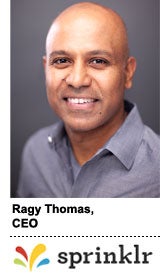
To make its product seamless, Sprinklr doesn’t integrate tech – it rebuilds it onto its own platform. Nanigans engineers will rewrite their code from the ground up to fit into Sprinklr. Nanigans has 12 core features that Sprinklr lacks, according to Sprinklr CEO Ragy Thomas.
“Most CTOs love the opportunity to take 10 years of learning and start over,” Thomas said.
With an IPO looming in the next 12 to 24 months, 10-year-old Sprinklr sees itself as a consolidator of the social media point solutions that emerged over the same period – including Nanigans.
Thomas spoke to AdExchanger.

AdExchanger: What tech holes does Nanigans fill?
RAGY THOMAS: Our product has always approached the ad buying process from a workflow and optimization perspective. We have built features for large, global brand advertisers. Nanigans focused on performance advertising needs. We want to be a leader in both, and create the best big-budget performance advertising solution in the marketplace.
The second reason is that as our ad product expands, we were looking to find people with long, deep-rooted advertising backgrounds. And as one of the older FMPs [Facebook Marketing Partners], Nanigans employees have that talent.
Do you expect to convert over Nanigans’ existing customer base?
We’re expecting to convert pretty much all of them. We can show them a path to a much broader omnichannel, omnifunctional infrastructure. The Nanigans clients we spoke to loved it – and that was the validation we needed to do the deal.
Is this deal a sign of mar tech and ad tech coming together?
We are the most avid supporters of that thesis. My personal prediction is that in 10 years, no one should be talking about advertising systems or marketing systems or even customer care or research systems. They should be talking about a front office platform when describing any customer-facing function, that same way you talk about the “back office,” not supply management or inventory management. You will always have a CRM system, but then you’ll pick one or two more platforms that all work together.
What role does paid media play in your platform?
We see advertising as a very strategic function. You can’t own customer experience and facilitate the customer experience without ensuring that brands have the tools to create and optimize personalized advertising.
Will clients be moving to a SaaS model?
I can’t comment on Nanigans’ past, but I can confirm that Sprinklr works on a software licensing model. If you want to, you could buy an enterprise license to run unlimited media spend.
You’re acquiring point solutions – can they survive on their own anymore?
We used to see hundreds of point solutions. What you should not do is integrate a social advertising tool with a social listening tool with a digital publishing tool with an advocacy tool with an influencer management and content management tool. We’ve built capabilities into a unified platform from 17 different point solution markets.
What’s different about how Sprinklr integrates these point solutions?
We’re not buying products and exposing them to customers, we’re rebuilding only the missing capabilities onto our platform. That’s the nuance a lot of people do not understand about Sprinklr. Whenever we buy a company, 30% to 60% are duplicated capabilities we don’t need to build. The single architecture with a single code base is the value prop.
How fast will Nanigans clients move over to Sprinklr?
We have a six- to nine-month timeline to have complete feature parity with everything they’re used to getting in the Nanigans platform. Then we just migrate the data on the backend, so it’s pretty seamless.
Why didn’t you buy Nanigans’ incrementality business?
Nanigans was looking to sell the social advertising part of their business, and this move was partially done to help the rest of the Nanigans team focus on incrementality.
What kind of outcome do you think this is for Nanigans?
Obviously, we closed the deal – so it was good.
This interview has been edited and condensed.








