

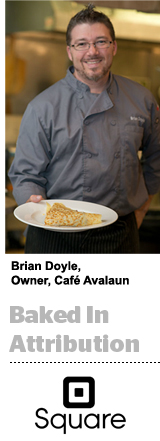
 As proprietor and chef at Café Avalaun, a gluten-free restaurant just outside of Cleveland, Ohio, Brian Doyle would rather cook, bake and make crêpes than spend his life on marketing.
“We don’t do a lot of traditional advertising because it’s expensive and it’s hard to know if you’re actually hitting your target audience,” said Doyle, who uses Square to handle payments, loyalty and CRM.
Coupons and discount codes close the loop, but not every online ad has a direct-response component and it’s mission critical for Doyle, as well as for most other small and medium-sized businesses, to find the shortest path between online ads and offline sales.
That’s the space where Square is looking to play in its bid for SMB advertising dollars. Local ad spend is on track to rise from $113 billion in 2015 to $132 billion this year, according to research firm Borrell Associates.
Square, known for its point-of-sale tech, has been rolling out a growing software suite of marketing and customer engagement tools centered on connecting online ads to transactions using its POS hardware as the glue.
That’s a big part of why Square has been cozying up with Facebook.

In March, the duo announced they would let SMBs use their sales data to buy Facebook ads directly through Square. In late June, Square deepened this relationship through an integration with FB’s offline conversions API to help small businesses attribute foot traffic in cases where there isn’t a coupon to redeem.
“We knew intuitively that there is a whole set of consumers who view ads online and then come into a store to buy something without ever clicking or bringing in a coupon,” said Saumil Mehta, customer engagement lead at Square.
Through the integration, Square merchants are able to establish a link between consumers who view an ad on Facebook – information Facebook is able to provide with its vaunted deterministic data trove – and in-store transactions, to which Square is privy through its POS tech.
The process is automated behind the scenes, so there isn’t any buyer or seller friction, Mehta said.
But there are still blind spots.
For one, the offline conversion tool only works if a consumer actually buys something. If someone walks into a store and doesn’t makes a purchase, there’s no way to measure that foot traffic or retarget that person by following up with messaging to try and complete the sale.
But Mehta claims that’s not much of an issue for Square’s SMB clients. When a consumer decides to go into a pizza shop or restaurant like Café Avalaun after seeing an ad on Facebook, the conversion rate is quite high.
“For the vast majority of buyer interaction at offline local businesses, when people walk into a store they have intent to transact there,” Mehta said. “People don’t generally showroom in local coffee shops.”
(Although they do sometimes camp out for Wi-Fi, something Doyle takes advantage of to help populate his email contact list. Visitors to his restaurant can access free Wi-Fi in exchange for sharing their email address.)
Although the conversions tool doesn’t provide perfect vision, the benefits seem to outweigh the edge cases. Doyle, who buys Facebook ads through Square, was able to attribute 35% of transactions driven by a recent Facebook campaign to customers who saw an ad and later went on to buy something without using a coupon.
“I’m seeing results and seeing them quickly, which is cool, and it’s making me realize that if you take a little time to think about this stuff and get clever with it, it really starts to pay off for you,” Doyle said.
But that doesn’t mean that Doyle, a one-man marketing team who spends the bulk of his day whipping up treats in addition to overseeing 10 employees, has all that much time to spare.
Which is why he’s looking for automation and ease of use. And time-starved SMBs are Square’s bread and butter.
“SMBs have small budgets and not much time, so we’re trying to help them know what works and what doesn’t automatically without them having to do too much,” Mehta said. “If you’re Brian [Doyle], you’re not a Facebook ads guy. Presumably you started a business because you want to run a café.”


