
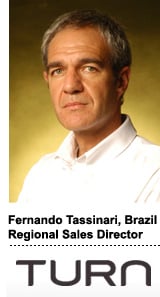
 Demand-side platform Turn has hired Fernando Tassinari, former CEO of marketing agency MRM Worldwide Brazil, to lead its Sao Paolo office with the goal of expanding Turn’s presence in the country and throughout South America.
“We’ve been working down there with US account managers and sales people for more than a year,” Tassinari said in an interview. “To date, we have something like 20 clients. The plan is to hire a couple local people in the coming weeks and grow our business down there.”
The full interview is below. Meanwhile, for more on Brazil, check out our special report on its digital ads and RTB.
AdExchanger: What’s your background?
FERNANDO TASSINARI: I have been working in this market since 1996, so it’s been a long time. I have experience in different kinds of companies, from agencies to publishers. In agencies, I’ve worked at Modem Media, Razorfish and MRM. On the publisher side, I worked mainly at Yahoo, and with technology companies I’ve worked at 24/7 Media down in Brazil. So I’ve had some experience in the local market.

Who do you see as your competitors in Brazil, and how will you differentiate Turn?
There are a couple competitors in Brazil. One of them is Google, always, because they are everywhere. What differentiates us from most of them is our technology platform.
Also, for the culture down in Brazil, we are very connected. It is different than in the US; in Brazil, usually you close deals during lunches or dinners. We get along well…so knowing a lot of people is going to make a difference. Of course, you must have a good product and service behind you, and this Turn has.
What are the goals for expansion in Brazil and across South and Central America?
We are opening an office in Brazil, hiring and starting a real operation in order to be top of mind and be one of the key players. We are someone who understands this market, and we expect to grow fast. We are going to get serious in the Brazilian market.
At first, we will be only in Brazil, but in the next quarter or so, we expect to hire in other countries like Mexico, Argentina, Chile and Colombia. We have clients in these countries, so we have to define internally if we are going to have some local people working there, or if we are going to serve them from Brazil. In Mexico, our plan is to starting hiring locally also.
Who are some clients in Brazil, and can you give examples of how you work with them?
We work with both agencies and advertisers. I can’t [say which] advertisers, but for the agencies we work with Neo@Ogilvy, Mindshare and Starcom in Brazil.
One thing that is unique about Brazil is that trading desks cannot exist in Brazil. There is a local regulation that the trading desks must operate through the ad agencies. In Brazil, we cannot have media agencies. So who buys the media? Who buys the ad pages? The creative agencies. They do both creative and media buying, per the local regulation. Neo@Ogilvy created its own trading desk internally, and it depends on the agency, but the other agencies use us for support.
How do you see the RTB market in Brazil right now, and how will it grow or change in the coming years?
RTB is still small, in my opinion. There is huge growth potential. I can clearly see that the advertisers and the major groups of agencies will lead and drive this change. There are also small agencies being created just for data as specialized RTB agencies.
The market is still young, like the US was three years ago, so we have a couple challenges in terms of education. There is going to be a learning curve…in Brazil that is going to take a while…[and] be a challenge.
We see the market growing, but it is still small compared to the US and even Europe. I see it as similar to APAC at this moment.
How do mobile and social media factor in Brazil?
Mobile is huge in Brazil, but in terms of ad spend, it is not that big yet. Mobile penetration is huge down there, but you have some infrastructure challenges, so the cost is too high. Many people buy smartphones, but they cannot get the access yet. 4G, for example, was just launched.
For social media, there is a social explosion in Brazil. Facebook has 70% penetration, and the time spent on Facebook in Brazil is the biggest in the world. It will be a huge differentiator for Turn as well, because we have access to the Facebook Exchange.
One issue we’ve recently covered is the competition between TV and online advertising. Will online advertising be able to overcome TV’s dominance?
I don’t think so. TV will stay huge in Brazil because it is cultural and there is a strong corporation, TV Globo, that dominates the market. What I believe, personally, is that the user behavior and the advertisers are going to change that model. Today, Globo TV imposes upon the agencies the way to buy media. They have quality and the penetration, but the audience is changing their behavior to online. It has already changed, and advertisers are following the audience behavior. So this is going to drive the change in the next couple of years.








