

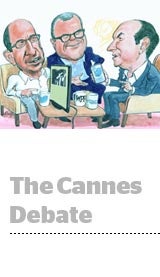
 In a wide-ranging panel at Cannes, CEOs Dick Costolo (Twitter), Philippe Dauman (Viacom) and Martin Sorrell (WPP) discussed the evolution of rich media consumption on mobile devices and why marketer investment in mobile video does not yet match consumer demand.
Sorrell, who opened the panel by stating WPP spends $750 million with Viacom (said Dauman: “Not enough.”) and $100 million with Twitter (up from $50 million last year), wondered about the latter’s evolution, given how Twitter has built capabilities that go beyond its core communication service.
Twitter’s focus, Costolo explained, is on pushing rich media content into the platform, from video to ecommerce services.
The CEO clarified chatter from as far back as January that Twitter would integrate ecommerce services into its platform. “We think about commerce in terms of in-the-moment commerce,” he said. This method involves building ecommerce capabilities that manifest in real time depending on what a Twitter user is doing, talking about or seeing.

Costolo cited two tests he said were successful. The first was with American Express – in which a consumer might see a tweet from an American Express merchant like Whole Foods, respond and get a discount at the merchant’s location by swiping an American Express card.
The second test was with Amazon, which enabled Twitter users to respond to an Amazon tweet with the hashtag #AmazonCart to add goods into a shopping cart.
Twitter’s acquisition of SnappyTV, a solution through which content providers can quickly extract and post snippets of televised content, emphasizes Twitter’s commitment to the video format. Costolo envisioned new business models emerging around easily created, short-form videos. “The models haven’t emerged yet, and now is the time explore different ways of framing this,” he said.
Despite its acquisition of short-form video creation and hosting service Vine in 2012, Costolo said the social network had zeroed in on hosting instead of original content production. “We’re really focused on content extraction from partners, getting it onto Twitter as quickly as possible, so you can have that immediate conversation,” he said.
While the production of mobile content is a need that’s largely filled by consumers, media companies like Viacom also are dipping their toes in. Besides its longer shows, Viacom develops short-form supplements designed for mobile devices. “We’re producing shows that we marry with not just clips from shows on TV, but additional content,” Dauman said. “You’re seeing mobile distribution companies create the technical capabilities to distribute this.”
But Sorrell pointed out that, despite consumer interest in short-form video content, the Twitter platform only accounts for 3% of mobile spending. Costolo acknowledged a gap between mobile video spend and mobile consumer attention, but buckled down and insisted that the explosion of rich media viewing on mobile devices presents a “massive opportunity.”
Dauman agreed. “Mobile is a huge opportunity for us,” he said.
The fact that advertiser investment doesn’t yet reflect consumer enthusiasm around mobile video, Dauman said, underscores the need for measurability and accountability.
“What we need to measure, as you all know, is mobile viewing, viewing on iPads and devices outside the home,” he said. “That’s coming next year. That will encourage more content that marketers will be comfortable advertising on and that will increase spending.”









