

 Lying in digital advertisements has become a flashpoint in US politics this year.
A running dispute between Elizabeth Warren’s presidential campaign and Facebook ratcheted up this weekend, after the Massachusetts senator posted an ad on the social platform featuring a lie that Facebook and CEO Mark Zuckerberg had endorsed Donald Trump for reelection.
“You’re probably shocked, and you might be thinking ‘How could this be true?’” according to the Warren ad copy. “Well, it’s not. (Sorry.) But what Zuckerberg *has* done is given Donald Trump free rein to lie on his platform.”
Warren was responding to a Facebook ad promoted by the Trump campaign lying about Joe Biden and his son, Hunter Biden.
In a tweet this weekend responding to the Warren campaign, Facebook said its standards are similar to broadcast TV, where there are laws about accepting candidates’ ads. The Trump campaign has aired the same claims on TV that it makes on Facebook, without the same blowback.
It’s unclear how this policy gels with Facebook’s claim that it is trying to reduce viral misinformation on its platform. However, Facebook VP of global affairs Nick Clegg said last month at the Atlantic Festival in Washington D.C. that the company doesn’t believe it should “referee political debates and prevent a politician’s speech from reaching its audience and being subject to public debate and scrutiny.”
Still, the issue of spreading lies at scale has metastasized to other major video ad platforms as well – namely YouTube, where the Trump campaign promoted an ad falsely claiming the president released a transcript of his call with the Ukrainian president.
Google told Judd Legum, publisher of the political newsletter Popular Information, that the ad doesn’t violate its policies prohibiting “misrepresentation” or intent to deceive viewers.

Politicians and Facebook
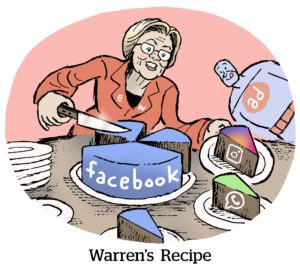
Warren’s intentionally misleading Facebook ad ups her beef with the platform, a conflict that goes back to her plan, published in March, to break up big tech companies.
Zuckerberg cited Warren’s potential election and tech antitrust plan as an “existential” issue for the Facebook, according to audio from Facebook open meetings obtained by The Verge.
Yet, Warren’s and other Democratic candidates’ concerns with Facebook haven’t impacted their own ad spend, which has gone mostly to Facebook and Instagram so far this year.
Whether political revenue is worth the cost for Facebook is an open question.
“The social network brought in more than $500 million last cycle, dwarfing even the biggest political targeting shops in our space,” said Jordan Lieberman, general manager of politics and public affairs at a4 Media, Altice’s targeted advertising business. “However, this cost $5 billion in FCC fines relating to Cambridge Analytica, and billions more in lost stock value. Facebook has virtually no chance of breaking even on political ads given their enforcement costs.”
Facebook’s efforts to stem outside electoral manipulation focused mostly on foreign bad actors, like the Russian operation to influence the US election in 2015 and 2016. Shady PACs and political pop-up groups can no longer hook up a credit card and pump lies onto the platform.
What Facebook and other major ad platforms need to reckon with this year is a different kind of problem, as the lies and misinformation now come from high-level US campaigns and the White House itself.







