

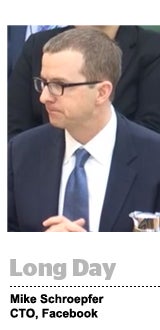
Facebook’s CTO, Mike Schroepfer, faced five hours of intense and technically savvy grilling by members of a parliamentary committee on Thursday. The takeaway: UK regulators don’t trust Facebook.
To put it more pointedly in the words of British conservative MP Julian Knight: Facebook is a “morality-free zone” with no respect for consumer privacy or the free press, and it can’t be counted on to effectively police itself.
The events of the last two years, culminating in March with the latest chapter in the Cambridge Analytica saga, has proven that self-regulation is “utterly worthless,” Knight said. “That’s witnessed by the sort of information free-for-all that we’ve had.”
Knight and his cohorts on the UK’s Digital Culture, Media and Sports Committee were unamused by the same earnest promises for greater transparency that seemed to assuage Mark Zuckerberg’s congressional interrogators in April.
“Transparency is good,” said committee chair Damian Collins, a conservative MP. “But transparency doesn’t allow you to stop what’s happening.”

Although Facebook has been under a consent decree with the Federal Trade Commission since 2011 after a previous privacy infraction, the company has largely been regulating itself for the last 14 years.
And nothing Facebook did, including shutting down the part of its API in 2014 that allowed developers to collect friend data, was able to stop Cambridge Analytica from accessing information through a third-party developer with hooks into the API that predated the 2014 change.
The academic researcher who created the app, Dr. Aleksandr Kogan, testified before the digital culture committee on Tuesday. He told members that he was able to play fast and loose with Facebook’s data, because of an obvious lack of scrutiny on Facebook’s part into the terms of service agreements it has with its developers.
Which leads to the question “How much does Facebook care?” said Labour MP Paul Farrelly.
Implied in the question was whether others, such as regulators, need to step in and care if Facebook doesn’t.
During his April testimony before the Senate Judiciary and Commerce committees in Washington, Zuckerberg said he was open to regulation as long as it’s the “right regulation.”
Schroepfer echoed the sentiment.
“The question isn’t if [there will be regulation]; the question is, honestly, how do we ensure that the regulation and practices achieve the goals you want?” he said. “The details of implementing all that is where the really hard work is.”
Europe has already done that hard work. After years of labor and debate, the General Data Protection Regulation is set to take effect in Europe in less than 30 days.
But that’s across the pond. In the US at least, lawmakers don’t seem to have the technical chops required to pass appropriate legislation. If Zuckerberg’s testimony before Congress proved anything, it’s that some legislators are on very shaky ground when they’re talking, or trying to talk, about technology.
“I’m terrified at the thought of legislation coming through those sorts of channels,” said Tania Yuki, CEO and founder of social analytics company Shareablee, during a town hall discussion on data collection and privacy hosted by the Advertising Research Foundation (ARF) on Thursday.
But a lack of technical knowledge on the part of Congress doesn’t mean the ad industry shouldn’t be regulated, said Allie Bohm, policy counsel at consumer advocacy group Public Knowledge at the ARF event. It just means that politicians need better technical advisors.
“I don’t know that self-regulation works,” she said. “You have to have a lot of good guys to make it happen, [and] if you’ve got one guy that decides to be Cambridge Analytica, it spoils the basket for everybody.”








