

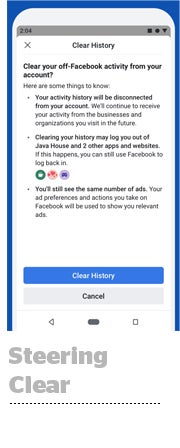
After more than a year of tinkering, Facebook is rolling out a long-promised tool that lets users see the data about them that third-party apps and websites pass to Facebook, and then decouple that data from their Facebook account.
Starting Tuesday, users in Ireland, South Korea and Spain will be able to access the feature, which Mark Zuckerberg talked about publicly for the first time at the F8 developers conference in May 2018 just a couple of months after the Cambridge Analytics scandal blew up.
Facebook wouldn’t say when exactly the Off-Facebook Activity tool will be available in the United States, other than to note that Facebook will continue rolling it out “everywhere over the coming months.”
But Facebook did reiterate a point it’s made in the past: Giving users the ability to scrub their data will affect Facebook’s business.

“This is something that could possibly impact our bottom line,” a Facebook spokesperson told AdExchanger, “but we’re moving forward and doing this anyway, because we think it’s the right thing to do.”
During Facebook’s second quarter earnings call, CFO Dave Wehner told investors to expect revenue to decelerate in the second half of the year and into 2020 due to “ad targeting-related headwinds” in the form of privacy laws, such as the General Data Protection Regulation in Europe, and thanks to Facebook’s own privacy-related product changes.
Third parties share all sorts of data with Facebook via widgets, the Facebook pixel, the login with Facebook feature and cookies. That user-level data includes search queries, clicks and purchases. Facebook passively collects data from tracking tools embedded across millions of sites and apps.
Facebook uses this information to help advertisers target their campaigns or track the off-platform performance of Facebook ads. A third party might know that someone using a particular device looked at a product, for example. If that device info can be matched to a Facebook account, Facebook can retarget ads about the product or related products either on its own properties or on Facebook Audience Network.
It’s a bit early to say how many people will actually use the feature to manage their data-sharing preferences, and Facebook declined to say the percentage of users it’s anticipating will opt out.
But the current fraught climate and nonstop negative headlines could encourage people who are normally laissez faire about online privacy to take action. To spread the word, Facebook is planning to run two mass market ad campaigns to promote the feature and educate people on how to use it.
Once Off-Facebook Activity is available in a certain country, users will be able to access it under their settings tab.
In addition to seeing a summary of the info that other apps and sites have sent Facebook through its developer and business tools, users can disassociate the information from their Facebook account either wholesale or app by app and site by site. Users can also opt to go nuclear and disconnect all future off-Facebook activity as a guarantee against any data sharing with Facebook down the line.
But why did it take so long to start shipping this tool? Perhaps it wasn’t a priority.
Facebook, however, asserts that its product team worked slowly on purpose in order to give privacy researchers, businesses and users time to share feedback. Facebook also claims that the process of disconnecting info about off-site activity from user accounts required a nontrivial redesign of the way its system stores and processes data.









