

Ad industry insiders have consistently warned that generative AI would ignite an explosion in made-for-advertising (MFA) sites that cynically monetize via programmatic ad tech.
Well, research is starting to prove the case.
A study released Tuesday by advertising supply chain intelligence company DecryptAds uncovered more than 2,100 AI-generated recipe sites that take a page straight out of the MFA playbook, with multiple overlapping ad placements crammed onto pages filled by low-effort content. DecryptAds found ads from major blue chip and Fortune 500 brands appearing on these recipe sites.
The report examines sites populated by AI-generated recipes, although the same publishers operate all sorts of other ad-supported sites, such as political news aggregators and car, anime and video game forums.
By examining ads.txt and sellers.json files, DecryptAds determined that the recipe sites appear to be monetized by SSPs that work with ad tech partners located in what DecryptAds refers to as “risky geos.” These “risky geos” are associated with high degrees of cybercrime or often have adversarial relationships with the US, according to Zach Edwards, co-founder and chief of product and research at DecryptAds.
The idea that US citizens – including, potentially, government officials – can access these sites, have their data harvested by ad tech vendors and possibly be targeted with malvertising schemes presents major cybersecurity concerns, Edwards told AdExchanger. However, he noted that DecryptAds has not uncovered evidence of any crimes committed by these sites or their ad tech partners.
Regardless, the ad inventory on the sites is of dubious value, Edwards said. Just like with MFA, the sites are packed to the gills with ad placements designed to game viewability.
They duplicate viral recipe trends or copy popular pages from other cooking sites to produce close-enough versions that were clearly not reviewed by a person. The sites sometimes feature crazy foods that only make sense as a bucket of search keywords (“Hot Cocoa Buffalo Chicken Gingerbread Dip with Marshmallow Topping, anyone?”).
But to anyone with eyes, it should be clear that these sites have no place in a healthy programmatic supply chain, Edwards said, especially in light of recent Google Search changes that deprioritize sites featuring AI-generated authors and creators.
But whether to serve ads on such sites is a choice that many SSPs are still grappling with.
AI avatars
Part of what makes these sites hard to police is that they’re built to look like the work of real people.
The networks of sites uncovered by DecryptAds feature fabricated authors on their “about” pages. These author profiles often include AI-generated human avatars or, in some cases, stock images, stolen pictures of real chefs and even slightly altered images of celebrities, such as actress Emily Blunt.
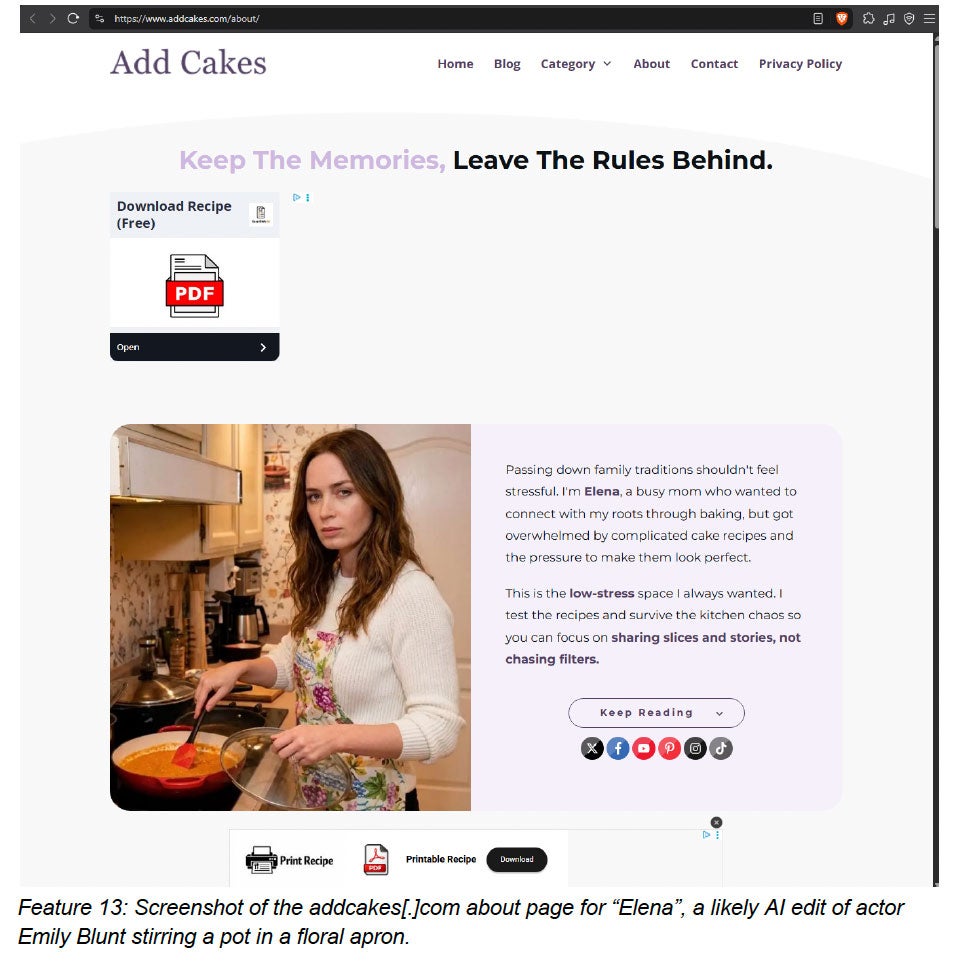
These sites rarely disclose that their authors are not real people, which means they run afoul of a Google helpful content update rolled out just this month.
The new Google Search policy states that “fabricating creator profiles (such as by using AI-generated headshots, made-up names or false credentials to make content appear as if it was written by human experts) is a form of deception. Any form of deception makes a page untrustworthy to both users and our automated quality systems, and is a signal of a low-quality page.”
According to Edwards, the advertising industry should take Google’s new policy as a sign that if websites don’t disclose their use of AI-generated authors, then the publishers and their vendors risk being officially classified as “low-quality” and therefore unfit for monetization.
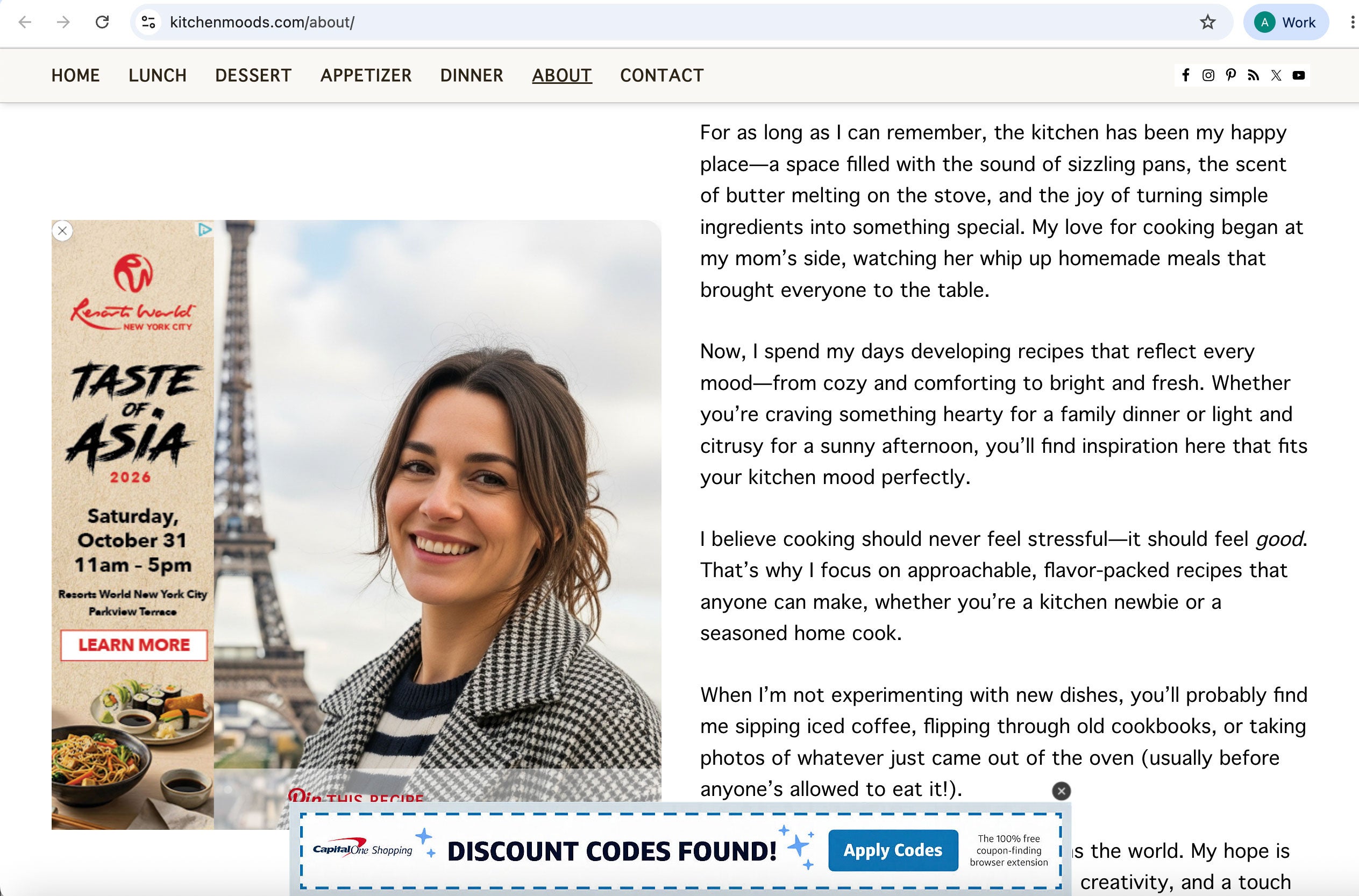
But according to a source at an SSP who spoke with AdExchanger on background in exchange for candor, the Google guidance only applies to Google’s search business and should therefore be treated separately from best practices suggested by Google Ads.
This source also disputed the premise that sites featuring AI-generated authors have no inherent value for advertisers or audiences. After all, real people click those links and engage with AI-generated content all the time, they said.
The DecryptAds methodology
But quibbling over philosophical questions about AI avatars and bylines is arguably beside the point.
After all, the issue appeared on the DecryptAds team’s radar, Edwards said, because of concerns about potential cybercrimes and state-backed bad actors exploiting the ad supply chain.
It’s worth reiterating that the report does not contain evidence of any crimes committed by the sites or their ad tech partners, Edwards said. The operators appear less like sophisticated threat actors than opportunists running a low-effort content-farm playbook.
But cybersecurity concerns did inform the methodology used by DecryptAds. The team first discovered the more than 2,100 recipe sites covered in the report during its regular monitoring of ad tech companies registered in what they consider “risky geos,” Edwards said.
Think Russia, China, Cyprus, Turkey and the United Arab Emirates. These nations, Edwards said, are either under direct US sanctions, have an adversarial relationship with the US, maintain little to no privacy firewall between the government and tech companies or have associations with high degrees of cybercrime and ad fraud. DecryptAds groups these nations into threat tiers, with US-sanctioned nations like Russia in the top tier.
DecryptAds started by examining the supply chains of about 300 ad tech companies based in these risky geos, Edwards said, eventually deriving a list of publishers working with those 300 companies. It got this data by looking at ads.txt files. DecryptAds also determined which SSPs work with those 300 ad tech companies by examining the sellers.json files maintained by the SSPs, as well as by looking at domain name system (DNS) data, SSL certificates and Google Analytics data.
Using a list of food-related keywords, Edwards narrowed the list of sites monetized by the 300 ad tech companies to an initial list of “400 suspicious recipe websites,” he said. He manually confirmed that each of these websites use AI-generated avatars while obscuring their true authorship. (AdExchanger tested several still-active URLs provided by DecryptAds, and most either immediately failed the AI sniff test or featured stock author images easily uncovered by a reverse image search.)
Then, DecryptAds analyzed the sites to create more than 190 “technical footprints” to find other sites operated by the same owners, Edwards said.
DecryptAds eventually found 2,116 such sites that had slipped into the programmatic ad supply chain via the convoluted reseller relationships between global ad tech partners. The technical footprints DecryptAds created also helped it track the ownership of some of these sites to additional risky geos, with many of the sites having social media profiles tied to Morocco and Algeria, Edwards said.
With so many intermediaries in the programmatic supply chain, Edwards said, it’s easy for shady site operators to blend in.
In some cases, he suggested, the monetization of these sites demonstrates that some SSPs and ad tech platforms aren’t effectively vetting publishers before onboarding. But he also acknowledged that even when SSPs try to strictly and proactively weed out MFA inventory or AI slop, junk can still slip through the cracks.
Vetting and verification
The DecryptAds research is a testament to how important ads.txt and sellers.json have been for spotting weak links in the programmatic chain. They’re all we have to publicly verify the relationships between publishers and ad tech vendors.
But ads.txt and sellers.json files are an imperfect transparency tool. The files are rarely updated by most publishers and can include errors.
For instance, one entry in the DecryptAds report concerns a site called dailytastekitchen.com. It flags HBAgency as the site’s SSP and highlights HBAgency’s connections to “eight ad tech companies on our risky geo list,” based on account IDs stored in the site’s ads.txt file. These eight companies include Between Digital (an ad tech company based in Russia), Mintegral (based in China), AdMatic (based in Turkey), Monetix Ads (based in the UAE) and four other ad tech partners based in Cyprus or Turkey.
But of those partners named in the report, HBAgency only works directly with Monetix Ads, an HBAgency spokesperson told AdExchanger.
“As far as we understand, Monetix Ads uses technology provided by AdMatic, but HBAgency has no direct commercial relationship with AdMatic,” the spokesperson said. “Monetix Ads and AdMatic are based in Turkey, a NATO member and EU candidate country that is not subject to sanctions. Monetix Ads went through our vetting process and operates under contractual data protection obligations consistent with GDPR.”
Furthermore, HBAgency tells AdExchanger that every publisher onboarded to its SSP is screened by an independent third-party fraud provider. It also screens publishers for invalid traffic and runs “enterprise-grade malvertising protection across our supply,” the spokesperson said.
They added, “We review publishers on an ongoing basis and disable accounts that breach our terms and conditions. We do not serve ads in countries, including Russia, Belarus, Iran and North Korea, and we do not accept publishers or work with partners based in sanctioned jurisdictions.”
But, according to the DecryptAds report, HBAgency is allegedly a monetization partner for 1,631 of the 2,116 AI slop websites it uncovered.
Whether the error lies in the methodology used by DecryptAds or in HBAgency’s vetting process is unclear – and illustrates the headaches advertisers and SSPs face when trying to avoid monetizing such websites, Edwards said.
“We purposefully tried to only mention the SSPs briefly [in the report],” he said, “because these things are so complex that it’s hard to attribute things back to any one specific entity with complete accuracy and confidence.”
What the SSPs and tech vendors say
Rather than pointing fingers at SSPs and ad tech providers, Edwards said, DecryptAds is trying to raise the alarm that more of this AI-fueled MFA inventory is going live every day, and the industry will soon be swamped by low-quality sites if no measures are proactively taken to force-shift budgets elsewhere.
Given the moving target nature of auditing the open web for AI content, AdExchanger asked the other SSPs and ad tech vendors mentioned in the DecryptAds report to comment on their quality controls for their publisher networks and ad tech partners. In addition to HBAgency, whose comments are reflected above, AdExchanger contacted Ezoic, Culture G, MonetizeMore, Between Digital and Mintegral.
Ad revenue optimization company MonetizeMore was flagged by DecryptAds as monetizing just 11 of the 2,116 AI slop sites. After AdExchanger provided a list of those 11 sites to MonetizeMore, its CEO and founder Kean Graham said, “We are not actively running any MonetizeMore demand or our demand partners on any of the 11 sites listed.”
The company also initiated a wider review of its publisher inventory in light of the report, he said, and is committed to demonetizing any sites that don’t meet its standards.
Graham added, “One site [flagged by DecryptAds], Bakerias.com, still has a legacy connection to our reporting platform but runs its own AdSense account. We do not monetize that publisher because the domain did not pass MonetizeMore’s high site traffic requirement and ad inventory quality standards.”
Graham also confirmed that MonetizeMore is aware of the recent Google helpful content update that says sites with AI authors are untrustworthy. He said Google’s guidance aligns with MonetizeMore’s existing publisher standards.

“Inventory that relies on deceptive authorship violates Google’s guidance,” he said. “We do not think advertisers should be buying it and we do not monetize it.”
Ezoic, which DecryptAds says monetizes 407 of the AI recipe sites in its sample, took issue with the idea that AI authorship makes content inherently low-value.
“The internet is filled with low-quality content, both human-written and AI-generated. We believe the industry should judge content by its quality and usefulness, rather than treating how it was produced as a substitute for that assessment,” the company said in a statement.
On how it screens publishers, Ezoic said it “has an extensive review process and rejects more than 98% of sites that apply. We evaluate the quality of a site’s content or tools, the audience it attracts and how meaningfully that audience engages. We use our in-house identity graph to evaluate visitors, combine automated checks with human review to assess sites and analyze brand safety and contextual relevance in real time.”
The company also argued that AI-generated recipes can serve real people and real advertisers.
“Consider someone who discovers a pot roast recipe on social media, visits the site and uses its instructions to prepare dinner. That is useful content serving an interested consumer and a meaningful opportunity for an advertiser to reach that consumer. Whether AI helped produce the recipe does not, by itself, determine its value. What matters is whether the recipe is accurate, works and delivers what it promises.”
Both Culture G (which DecryptAds says monetizes 34 of the AI recipe slop sites in its sample) and Between Digital (which is mentioned in the report as an ad tech provider registered to a risky geo) did not reply to requests for comment.
Data security in ‘risky geos’
Mintegral, the last company AdExchanger contacted, did respond, though its comments focused more on the report’s data security concerns.
Although Mintegral was listed among HBAgency’s ad tech partners for monetizing the site dailytastekitchen.com, a Mintegral spokesperson told AdExchanger that the company “reviewed our records and found no record of having served ads directly on the specific site referenced in the report.”
They added, “We do not support the use of fabricated author identities or credentials intended to mislead audiences or advertisers.”
Regarding the vetting of publisher inventory for AI-generated content, the Mintegral spokesperson said that its “core business focuses on mobile in-app advertising. While limited mobile web inventory may be accessed through third-party advertising exchanges, this is distinct from directly onboarding traditional content websites.”
“Regarding third-party web traffic,” the spokesperson continued, “we receive standardized bid data from our exchange partners, subject to applicable data protection and privacy safeguards. These partners operate under legal and privacy vetting designed to limit the data to what is necessary for advertising purposes and to comply with US privacy law.”
And, regarding concerns raised in the report about Mintegral being based in a “risky geo” (China), the company spokesperson said, “Mintegral has no history of security incidents or regulatory actions concerning user data, and has not been subject to any government requests to access user data. It’s important to distinguish between legitimate questions about data security and generalized assumptions based on a company’s geographic associations.”
Correction 10/20/26: This story was updated to clarify that DecryptAds based its summary of which ad tech partners worked with HBAgency to monetize the site dailytastekitchen.com on account IDs stored in the publisher’s ads.txt file, not HBAgency’s sellers.json file.