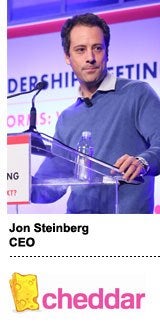
 Year-old video news startup Cheddar is shaking up the current media model in two ways. On the content side, Cheddar wants to be the CNBC for millennials, quickly offering business news about the companies they care about.
On the business side, Cheddar doesn’t see advertising as a main revenue driver. Instead, it’s struck deals with OTT partners and platforms, often with subscription fee and advertising revenue shares. Those platforms include Dish Networks’ Sling TV, Amazon Video, Roku, Vimeo and Apple TV.
If Cheddar succeeds, it will usher in a new era in digital media monetization. The digital space will start to look a lot more like the cable TV space.
Founder Jon Steinberg, the former president of BuzzFeed who has also served as the Daily Mail North America CRO, has raised $13 million to date, including from Comcast Ventures, which he says helped him understand the cable TV business model Cheddar is emulating.
After a speech at the IAB’s Annual Leadership Meeting in Hollywood, Fla., he sat down with AdExchanger to discuss the future of digital media.
AdExchanger: You’re a startup. How do you create content worth paying for without scale?
JON STEINBERG: We are on paid platforms, where we get paid a carriage fee. And we keep our direct sponsorship revenue. We do native sponsorships directly into the show. We’ve got Fidelity, Dunkin Donuts, HP. It’s a version of the live read, and it’s a light lift for the brand and a light lift for us. I call it native 3.0.

You’ve described your programming as “ambient linear.” What does that actually mean?
When you do watch CNN, MSNBC or CNBC, you tune in to see what’s happening. No one knows the name of any of the shows on CNN. It’s a different behavior than sitting down to watch two episodes of Stranger Things. It’s radio versus playing an album.
Some cable companies see advertising revenue decline as distribution revenue increases. Where will that split end up for them? And for you?
It’s a dollars-to-donuts situation. If they are giving you a higher fee, they probably want more of the available inventory that runs against the show. If you can prove that you can sell your advertising inventory, and there is demand for content, they inevitably give you a higher fee because they want to own more of that advertising.
If people like us prove the value of the content and prove the advertiser demand, the fees go up and the advertising revenue goes down. But they are interchangeable; they go back and forth between each other.
Why else would the platform increase what they pay for content?
Verizon Fios is going to need a lot of content. AOL is going to need a lot of content. They are going to be better at targeting ads, and they’ve got more data [than the content provider]. They are going to need high-quality inventory. The way to get that inventory is to write people a check for the content – that’s effectively what we are hearing from Snapchat.
So will Snapchat write checks to its Discover partners, instead of the current model where publishers sell ads against their own content?
Yes, of course they will do that. Because then they can sell advertising across all of Snapchat. And they will be better at selling Snapchat than someone else selling Snapchat. It makes sense.
A lot of publishers talk about content customization for each platform. You guys work across a bunch of platforms …
I don’t want to do anything any platform wants me to do. Facebook wanted short videos. And then the decided they don’t want short videos. If you do what they you want to do, you waste a lot of money and time.
Subscriptions seem like a trend now, whether it’s news media benefiting from a post-election bump or startups like Sourcepoint working to create micropayments. What’s your take?
Standalone subscriptions for standlone services? I don’t think that will ever be a giant business. Most people want to pay for bundles of content. The same way Netflix charges people and the people who make “House of Cards” get paid for the content, I think that’s how it will play out in news and entertainment.
Cable channels get a ton of money, just like newspapers did when they were thriving. New entrants in digital video have the opportunity to replace some of these high-priced incumbents. These new bundles have to sell at a lower price point than the $150 per month people pay for their cable channels.
Some say that bundles comparable to a cable package should be about $100 per month.
You can get a Sling package for $20 per month and pair that with Netflix ,and your all-in cost is $30. Broadband you can get for $20 to $40. You’ve probably saved $50 per month right there. A lot of the expensive stuff, people don’t want. Fifty percent of Americans never watch ESPN. The reason we are seeing single-digit declines in cable subscriptions is that the first generation born of YouTube is getting their first apartment, and it’s never occurred to them to get a cable box.
You’re on a bunch of platforms. Which one is underrated right now?
Sling. It’s an incredible OTT product and provides enormous value to the consumer.
You used to work for BuzzFeed, which also had an alternative format that threw people for a loop, in terms of measurement. Are there lessons you’ve learned from that?
When you start with a new format and a new ad idea – and this is where I disagree with Randy [Rothenberg] a little bit – advertising by its nature has to be innovative. The creative and format needs to continually evolve. That means it’s hard to adopt standards. But if tomorrow morning, there were choices to rigorously measure everything we are doing, I’ll take any third-party measurement anyone wants to apply – especially if they pay for it.
What are your plans this year?
We will re-launch our app with live functionality by midyear. We will be on two more major OTT systems. We will go from six hours to 10 hours of live programming. We will build another control room and one more studio. We’re at 60 people, and we will be north of 100 by the end of the year.
This interview has been condensed and edited.