
 Premium direct sales and real-time biddable display advertising … can they co-exist?
IDG Enterprise thinks so. The owner of top-tier B2B media brands Computerworld, CIO, Network World and InfoWorld announced last week (see the release) that it has plunged into the exchange model in search of programmatic ad dollars.
According to IDG Enterprise CEO Michael Friedenberg, the strategy is to couple its premium owned-and-operated brand with a data-driven strategy that addresses the audience-buying desires of advertisers. The private exchange, called IDGEx, provides for programmatic real-time bidding of visitors to IDG TechNetwork’s 500+ publisher sites — using IDG Enterprise first-party audience data fed by 8 million monthly uniques.
As AdExchanger readers may recall, way back in 2011, IDG TechNetwork enlisted the services of Admeld — before it was acquired by Google — to create the first iteration of its private exchange strategy. Google remains the provider today with Data-Management Platform (DMP) services coming from BlueKai.
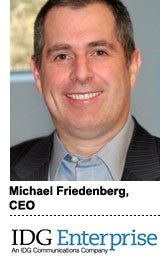
IDG Enterprise CEO Michael Friedenberg discussed the strategy last Friday.
AdExchanger: Why isn’t IDG Enterprise owned-and-operated inventory in IDGEx, your private exchange?
MICHAEL FRIEDENBERG: Currently, we are selling that inventory directly. Our sell-through rate is very, very high — over the 95% level. IDGEx gives us an ability for us to go out to our advertisers and provide quality with scale.

Right now, our coverage of the senior-level IT decision-maker is great in our owned-and-operated properties and yet most of our properties are serving a finite audience. Consequently, our advertisers are asking for more. The best way to provide more is to extend beyond our sites.
That’s why we’ve extended and partnered with IDG TechNetwork.
What about retargeting IDG Enterprise audience across a DoubleClick Ad Exchange or Yahoo Right Media Exchange and so on?
We’re happy with the additional reach that we’re providing through IDG TechNetwork. There’s always opportunities to go further out in the ecosystem, but right now the partnership exists just with IDG TechNetwork.
Is cannibalization of your inventory something you’re thinking about here?
At IDG, you always have to be willing to test yourselves and not be fearful of cannibalizing any of your business. Ultimately, your customer is going to drive your business. I’m not too worried about cannibalization because it seems to me the budgets are quite separate and distinct in the marketplace.
If anything, I’m looking at this as incremental opportunity for us to serve our customer in a new manner. We obviously have our direct-sales organization, aligned with our premium owned-and-operated brand, and here we have an opportunity to extend in buying with the trading desks, something we have no expertise with, and that’s why the partnership with the TechNetwork is so valuable to us.
What are we talking about in terms of pricing levels with IDGEx?
Right now, we’re starting with a $15 CPM floor, and then pricing changes based upon the “selects” that the advertiser wants to make. Of course, it’s a bidding system, so it’s up to the advertisers to choose what they’re willing to bid.
So, for example, you have some interesting data sets there that might bring the floor price up — if you’re going to target CEOs, that’s going to cost you a little bit more?
Exactly. It’s not only by title, it’s also by demographic, company size and then also contextually. We can align with the content that they’re consuming. Our ability to marry that data, both from a demographic and contextual side, is going to be something that’s quite valuable out in the market.
Does IDG Enterprise address the marketing-automation side of things? Do you see programmatic headed in this direction?
My opinion on this is that programmatic is definitely going to impact every element of digital services moving forward. Right now, programmatic is primarily just focused on the brand side. However, I do think, in time, with the right offering, there’s no denying that a data-driven strategy is also going to dramatically impact the demand-gen side, and then how that spills over to programmatic, either programmatic direct or programmatic in a real-time bidding manner for the demand-gen side, will be impacted in time. We are certainly watching it closely. We’re not in the position to make any announcements yet.
Are you doing anything yet in terms of matching CRM databases against your database to help businesses target users?
I think moving forward you’re going to see more and more media companies strategically partner with their customers behind the firewall. The ability to connect your data pipes and allow that to flow back and forth in a protected environment that ends up being a win-win proposition for both the advertiser and the media company is something that I think most media companies will move toward in the foreseeable future.
How do you think this might work with your LinkedIn agreement (announced in June) down the road?
A lot of that has to do with LinkedIn more than us. It’s just a matter of what I said earlier. Data is very valuable. It used to be that it was only the audience in your content that was valuable. Now, you’re seeing the third leg of the stool being the data that is driven either by your content or by your audience. The ability to partner with companies in a protected way is going to be essential.
Also, you’ve got to be careful in how you protect that data because if you make a misstep, that could be very detrimental to your overall business model.
The LinkedIn partnership that we have right now is content-based. It’s not data-based. In any partnership you certainly have conversations, but right now our partnership is 100% centered on the content side.