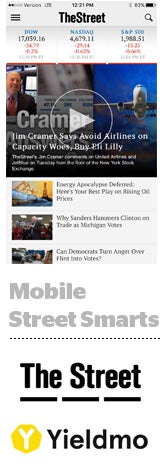
 TheStreet is kicking standard mobile banners to the curb.
Although the financial news and services site will still use them for internal ads and self-promo, banners will no longer be part of its sales team’s repertoire for apps or the mobile web.
That’s because mobile consumption is moving steadily up and to the right – but monetization is an ongoing dilemma for publishers with desktop roots. TheStreet.com is a classic example.
Since adopting responsive design last March, TheStreet’s mobile traffic has increased exponentially as readers increasingly access content on their phones. TheStreet’s advertisers, however, have taken a little convincing.
And that’s because the majority are direct marketers. They mainly care about the conversion, said James R. Freiman, SVP of media revenue, audience and business development at TheStreet, and mobile banners aren’t really cutting it in that regard.
In fact, a number of TheStreet’s advertisers will only run desktop and tablet campaigns, eschewing smartphones where the metrics are murkier and often more focused on branding KPIs.
“That left me with a challenge on the monetization of my mobile traffic,” Freiman said. “With a mobile site, the 320 x 250 just doesn’t work – it’s too big. No one has come up with a magic bullet ad unit that works for mobile.”
That includes the Interactive Advertising Bureau, said Freiman, who sits on its Mobile Advertising Committee.
“It’s definitely a universal issue, when we talk about digital dimes and mobile pennies,” he said.
To that end, TheStreet is working with private mobile ad exchange Yieldmo to monetize its mobile web and app article pages, including videos and photo galleries, without resorting to what Tom Foran, Yieldmo’s president and COO and the former CRO of Outbrain, called “trickery.”

“Some companies cleverly place their banners near to navigation so people click by mistake, others use pop-ups or interstitials that interrupt the user experience,” Foran said. “TheStreet knows that mobile is going to eat the world, but they want ads where the user initiates engagement.”
It’s a valid concern. Around 60% of clicks on mobile banner ads are accidental, according to a report released by Retale in February, which also found that 65% of people encounter the most banner ads when checking news sites, like TheStreet.
Although TheStreet had experimented with other mobile monetization partners in the past, including Millennial Media before it was scooped up by AOL and AdMarvel before it became a part of Opera Mediaworks, “they were doing nothing for me,” Freiman said.
TheStreet was Yieldmo’s first publisher client in 2012, and in January the duo expanded its partnership. Now, in addition to selling Yieldmo units directly – Yieldmo incubates an internal creative ad lab to develop proprietary mobile formats – TheStreet is also tapping into Yieldmo’s exchange platform for access to the latter’s advertiser relationships, which include Intel, DISH and Goldman Sachs.
Over the past few months, TheStreet has seen increased revenue, CPMs and fill rate, Freiman said. And rather than struggling to monetize all of its mobile traffic each month – it’s still hard to keep DR advertisers investing in mobile campaigns month by month “because they’re looking for the same results they get on desktop,” Freiman said – TheStreet relies on Yieldmo to pick up the slack.
Mobile monetization is still a work in progress at TheStreet, but one thing is clear – the standard mobile banners aren’t the way forward. That said, mobile display is just hard to pull off without being annoying or irrelevant.
“It’s not just about size [of the ad], it has a lot to do with why people are there,” Freiman said. “On mobile, they’re just there to get what they need quickly and then move off. … You need stickiness. People have to react to what you’re doing.”