

 Recipe publishers have realized they can tap into shopper marketing budgets by making their recipes shoppable. Matching brands and stores to relevant recipes requires technology, and the arms race is on.
Meredith Digital on Monday acquired Grocery Server, which provides technology to make recipes shoppable.
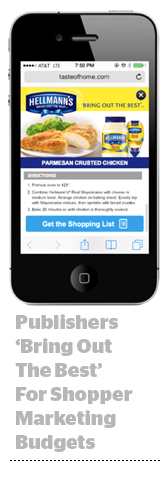
Separately, Reader’s Digest-owned Taste of Home, once a customer of Grocery Server, partnered with mobile advertising company Crisp Media. Together, they will create branded recipe ads that drive customers to stores.
Shopper marketing, which focuses on in-store displays and shelf placements, has traditionally been separate from digital advertising budgets.
But mobile phones have changed how people shop. “There’s a new placement vehicle in the store,” Readers’ Digest CRO Rich Sutton said. “It’s a mobile phone, and it’s effective.”
Buyers are taking note of publishers that can adapt to changing consumer behavior.
“Across the spectrum, brands are thinking more and more about investing in digital technology partnerships that will get them closer to consumers,” said Ann Strini, VP and strategy director for Wunderman New York.
Getting closer to consumers – and showing brands the value of being there too – fueled the Grocery Server acquisition.
“The ability for our systems to communicate and drive value for consumers and brands completes an important part of the puzzle,” said Marc Rothschild, SVP of Meredith Digital. “Being able to able to demonstrate attribution and conversion to a brand – it’s a critical piece of our success.”
Besides tapping into shopper marketing budgets, the Grocery Server deal will hopefully let Meredith serve advertisers at every point in the conversion funnel.

“Meredith now owns that full stack from top-of-funnel awareness to driving to a purchase,” Rothschild explained. “After we’ve spent time with the ‘why’ of that brand, we can tell them how and where to buy it.”
Meredith’s recipe site, AllRecipes, which has worked with Grocery Server since April 2014, attracted Target, Unilever and Del Monte during that time. Taste of Home runs recipe ads for Unilever’s Hellman’s Mayonnaise.
Both of the solutions track engagement with recipe ads to store visits or sales.
Meredith is working with Nielsen to add an attribution piece to its recipes that drive people to stores. Crisp Media uses location analytics company Placed to measure store traffic lift.
Both Grocery Server and Crisp Media focus on creating native brand integrations with the recipes – “their technology platform and our content platform,” Sutton quipped.
AllRecipes uses Grocery Server’s technology to match a brand’s product with recipes containing that ingredient. Other calls to action show what items are on sale at a local retailer, or suggest related products, like paper towels for a messy recipe.
Taste of Home allows advertisers to put their product directly in the recipe, so it can call for “Hellmann’s Mayonnaise.” Those recipes can then be turned into ads that appear on Taste of Home and on Crisp Media’s network. When users click on the ads, it reveals the full recipe, which users can save or email.
Other categories besides food are also ripe for this kind of native integration. Reader’s Digest sees options around its namesake publication for drug companies to drive people to pharmacies, or DIY projects in The Family Handyman driving people to home stores.
Meredith, with its female-oriented focus, plans to apply the technology to the beauty category. It will expand the tech, too.
“You’ll see us roll this out to our other food properties,” Rothschild said, “start to apply this in an ecommerce setting and in an in-store beacon setting.”







