
The Creative Renaissance Is Upon Us: The State Of Creative Advertising Technologies
Presentation by: Joanna O’Connell
Every advertiser has probably fantasized about living in the “Mad Men” era. Back then, advertisers spent their days cooking up the next “Big Idea” and creativity was the name of the game.
These days, creativity still plays a role, but it’s no longer enough. The problem is that the “Big Idea” process is incredibly time-consuming, with little room for optimization.
These days, you just don’t have that kind of time.
To increase efficiency, modern advertisers now rely on massive amounts of data, using it to target consumers across channels, formats, and devices.
But in their race to keep up, many advertisers have fallen to the other end of the spectrum — relying too much on data, while failing to adapt their creative process to the pace of modern advertising.
That’s where Creative AdTech (CAT) steps in. According to Joanna O’Connell, VP at Forrester Research, CAT represents the future of the creative process.
CATs still in its early stages, so if you aren’t thinking about it yet, you’re not alone. However, it’s definitely time to start.
HOW TO: Integrate Creative AdTech into your future advertising
- Evolve the “Mad Men” creative process to fit the new, omnichannel landscape
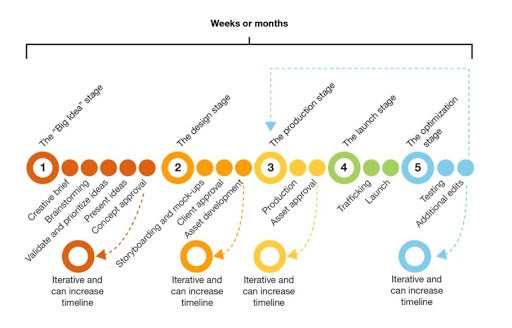
Compared to the old model, the modern creative process needs to be faster, more iterative, data-infused, and collaborative.
Where the old model looked like this →
The new model should look something like this →
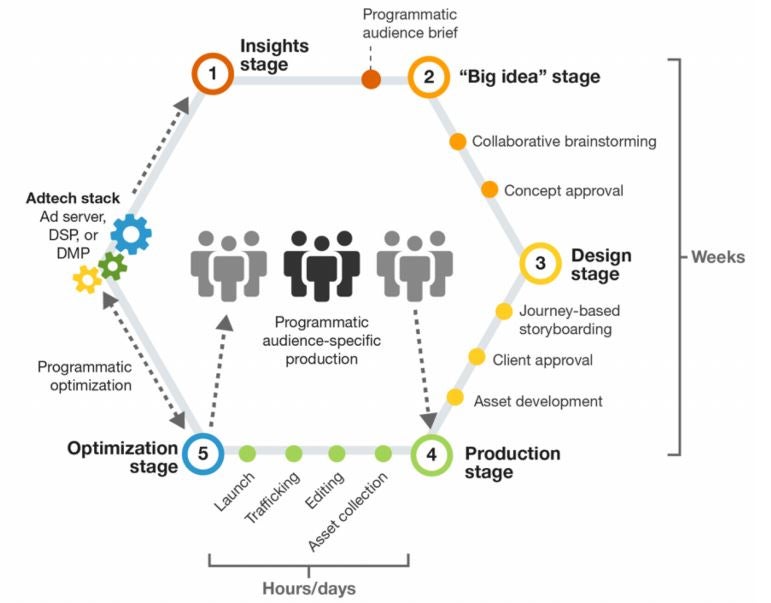
Note that the new model doesn’t progress in a single direction. Instead, it’s an ongoing process that moves across many people over time, with data constantly flowing in and out. It also doesn’t kill the “Big Idea” — there’s still space for human creativity, it just doesn’t start and stop there.
- Embed data into the creative process right from the beginning
CAT is a great tool to generate data-driven insights. However, they won’t do any good if your creative team comes up with a “Big Idea”, then slaps the insights on as an afterthought. Your team must utilize data from the very start.
Most companies are turning to CAT for 3 major reasons:
- To match creative assets to target audiences
- To streamline the creative development process
- To improve speed-to-market
CAT isn’t restricted to a particular media management style — current users fall evenly along the spectrum between relying 100% on agencies to being 100% in-house.
Interestingly, 52% of the decision-makers implementing this technology are marketers. While most are happy with the service from their CAT partners, they need lots of help implementing the technology. They also don’t exhibit much brand loyalty, an indication that it’s still a very young market.
- Evaluate a potential CAT partner based on 4 specific factors
In general, CATs come in two flavors — standalone and consolidated stacks. Regardless of the type, evaluate them based on 4 attributes: versioning, ad assembly, decisioning offerings, and cross-channel/cross-format capacity.
Here are a few potential partners you can look at →
- Make your CAT accessible to all creative parties to improve efficiency and control
CAT will allow you to improve your speed-to-market, as well as maintain control across sub-brands. However, in order to maximize these benefits, your CAT needs to be available to all the parties involved in your creative process.
Despite the number of parties it needs to reach, most companies only take 1-2 months to get a CAT up and running.
- Let CAT supplement your foundation of strategic, omnichannel thinking
While the technology is great, it should never replace human-led strategy. Embed an omnichannel approach from the beginning, and use the technology as a supplement, not a substitute.
- Prepare for a quickly evolving market in the coming years
Joanna predicts a few major trends, including an increase in AI capabilities, expansion into more channels, and improved cross-channel capacity. She also hopes to see better self-service and collaboration opportunities, as well as deeper integration with media decisioning.
Keep an eye on these market trends as they develop, in order to stay on top of this cutting-edge technology.






