
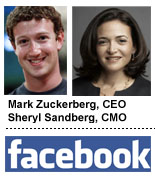
 An hour after producing a Q3 earnings report that exceeded Wall St. analysts’ expectations, Facebook CEO and chairman Mark Zuckerberg came out swinging against doubts about the social network’s mobile footing.
“I want to dispel this myth we can’t make money on mobile,” Zuckerberg said in prepared remarks. “The reason is, we haven’t really tried to [generate revenue from mobile] before. About 14 percent of our revenue now comes from mobile. That’s $150 million. Opportunity in mobile is most misunderstood. There are three trends coming together: First, mobile will give us the opportunity to reach way more people than desktop. Second, people on mobile use Facebook more often. And, third, long term, I think we’re going to monetize better per amount of time spent on mobile than desktop. All of these combined together make mobile a much larger opportunity for us than I think most people realize.”

Facebook took a net loss of $59 million in Q3, versus a profit of $227 million a year ago. On the bright side, revenue rose 32 percent to nearly 1.3 billion, with $1.09 billion coming from advertising. Total revenue was just above analysts’ forecasts, Bloomberg’s Brian Womack reported. On user growth, Facebook hardly seemed to disappoint. The company said that 60 percent of its 1 billion-plus members are using its mobile apps, compared with about 47 percent a year earlier, proof, Zuckerberg and Sandberg say, of a solid foundation for an ad business.
In terms of avoiding cannibalizing the desktop-based ad revenue, Zuckerberg and COO Sheryl Sandberg both noted that the larger focus is on ad integration as exemplified by the Promoted Post product that debuted recently. “For the most part, our ad inventory was in the right-hand column, but now we’ve told every product team that they are each responsible for developing their ad programs. For example, the Newsfeed team is figuring out how to place more ads within the feed without sacrificing user engagement and the experience. The same is true for the team working on Timeline or other areas.”
Some of those other areas include e-commerce, in the form of the forthcoming Gifts tool. “People already send millions of birthday messages a day using Facebook, and a lot of them have asked to be able to do more,” Zuckerberg said, setting expectations high. “Gifts provides us with the opportunity to learn about how people buy things and will hopefully help us build better services in the future.”
Aside from ad integration, Sandberg sought to highlight early favorable results for the Facebook Exchange. She rolled out a stream of stats demonstrating return on investment in the double digits, with demand side platform MediaMath and retargeter Tell Apart reporting ROI of 40x and 10x on the Facebook Exchange versus unidentified other platfiorms, respectively.
But when asked about the amount of inventory and conversions occurring within the Facebook Ad Exchange, Sandberg said it was still too early — “We just exited beta in September,” she noted — for it to have measurable impact on revenues.
Early reaction to Facebook’s results was generally positive, though there was creeping disappointment with the pace of new offerings. “Of the 12 new (early stage) monetization levers we track at FB, only Sponsored Stories likely had a meaningful impact in 3Q,” Brian Pitz, an analyst for Jefferies, said in a research note.
While Facebook appeared to stumble in the days after its IPO a few months ago, the doubts regarding its revenue capabilities are starting to dissipate in the face of the more typical high expectations. This partly reflects Facebook’s obvious and unprecedented scale. But the other part is Facebook’s skilled storytelling. And much of the credit goes to Zuckerberg’s more comfortable, less cocky stance coupled with Sandberg’s understanding of what marketers, big and small, want to hear.
At one point, Sandberg cast Facebook’s value to advertisers is the clearest terms when she mentioned that the social network’s audience every day is three times larger than the 111.3 million NBC Universal said watched Super Bowl XLVI last February. Of course, raw audience numbers are one thing. Cognizant of that, Sandberg was ready when the question of engagement came up.
“if we’re measuring engagement and the results from page post ads, comparing them when they’re placed on the right-hand side to those that are being placed in the Newsfeed. Comparatively, the ones in the Newsfeed – and that’s on both mobile and desktop – are eight times more engaging, and we see 10 times the ad recall,” she said, practically daring analysts to tell her what other sites can produce that kind of affinity.









