

 Pinterest’s advertising business took its next step toward scale with the official launch of its ads API on Thursday.
The ads API, which Pinterest introduced in beta in April, comes on the heels of a flurry of brand-focused products from the social platform, including an imminent buy button, a content API for businesses to manage and optimize organic posts, audience targeting capabilities and cost-per-acquisition/cost-per-engagement pricing on Promoted Pins.
It’s all part of Pinterest’s larger mission to become a go-to tool for brands along the lines of Facebook and, to a lesser extent, Twitter.
“The program and our partners are there to help build tools and services to help establish a more complete and scalable product across paid and organic,” said Jyri Kidwell, head of marketing developer partnerships at Pinterest.
Eight companies were named as Marketing Developer Partners (MDP) for ads – 4C, Adaptly, Ampush, Brand Networks, HYFN, Kinetic Social, SocialFlow and SocialCode. And that’s where it ends, for now. Pinterest is keeping its ads API invite-only for the moment, although that will likely change down the line.
The ads API, which also supports mobile, is auction-based and operates on a cost-per-click (CPC) model, with targeting limited to terms, device, geo and gender.
According to Kidwell, additional pricing options and targeting criteria will become available as the program evolves.
It’s also part of Pinterest’s near-term objectives to allow advertisers to bid on buyable pins through the ads API, although there’s no specific timeline in place as of yet.
According to Don Mathis, CEO of Kinetic Social, one of the companies within Pinterest’s inner MDP sanctum, many of his advertisers have been clamoring for an ads API offering from Pinterest.
“Twitter is great for discussing trending news and opinion and Facebook is great for catching up with friends, but Pinterest is somehow more aligned in an intrinsic way with consumers looking for something and then buying it,” Mathis said. “Consumers are starting to use this platform almost like a form of ecommerce search.”

That’s certainly something that’s top of mind at eBay, which ran its API tests with 4C.
“When we think about Pinterest, we think about being where the user is at the moment of inspiration so they can find the items they’re looking for,” said Llibert Argerich, head of social channels at eBay, who noted that eBay has seen a significant increase in traffic from Pinterest to its properties once eBay switched from CPM pricing to CPC pricing through the API.
High intent users are great, but at the same time, Argerich said he wouldn’t mind a little retargeting functionality in due course.
“Retargeting users directly when they search for specific things on Pinterest based on what they’ve done on eBay – that’s the end game for us,” he said.
Sandal and casual footwear brand Teva, on the other hand, was attracted to Pinterest as a sort of hybrid engagement/ecommerce platform, said Kirby Todd, social media manager at Teva’s social agency, Heat. Teva was one of Kinetic Social’s pre-launch API brand test partners.
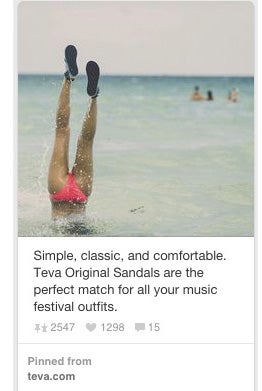 The agency worked with Teva to change its image from an adventure brand to one more associated with lifestyle and fashion through a campaign centered on summer music festivals. Heat tested fashion-, music- and travel-related organic content on Pinterest to see what worked, using the best results as a model for its Promoted Pins. The agency collaborated with Kinetic Social on targeting and execution.
In Kinetic Social’s tests with Teva and others, Mathis and his team noticed that paid media on Pinterest seemed to have a somewhat longer shelf life than promoted content on other social platforms.
“We’re seeing between 15% and 30% of the total value from Promoted Pins coming from earned media,” Mathis said. “It’s early to say, but there does seem to be an impressive half life for pins that we haven’t seen with other formats we’ve worked with.”
Paid media aside, Pinterest’s continued forays into advertising are key for a company that relies on brands for the majority of its content.
“Two-thirds of all pins come from brands or business websites,” said Eva Papoutsakis Smith, head of marketing communications and insights at Pinterest, speaking at an eMarketer event in March. “If you removed all of that, there wouldn’t be a Pinterest.”








