

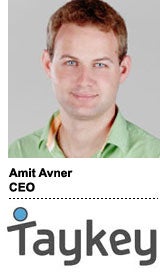
Taykey does real-time advertising, but not the kind you think. The company builds media plans for its large brand ad clients based on what their target audiences are buzzing about right this instant. Those media plans are executed on Facebook, Google, YouTube, and as of this summer, Twitter.
Founded in Israel three years ago, Taykey has since opened offices in New York and Chicago, and has plans for London and L.A. outposts this year.
AdExchanger spoke with CEO Amit Avner.
What problem does Taykey solve?
AMIT AVNER: The company does what we call topical advertising. Basically, the concept is that every 60 seconds a lot of things happen online. Viewers online are very agile, very dynamic, and we think that advertising should be agile as well.

All the big brands want to be attached to big things. Everyone buys Yahoo Because they want to be where everyone goes. Everyone buys the Super Bowl and American Idol and the Olympics, because they want to be attached to big events that matter, and that people are obviously emotional about.
We monitor 50,000 different sources of data online, in real time. It’s a billion data points a day, which we monitor in real time. We have a very unique technology. We have 30 engineers in the company who do all the data analysis to find what is topical for your audience, right now. We find what matters to your audience, right now, no matter how big or small it is, no matter how long it lasts ‑‑ for five hours or five minutes ‑‑ and we activate media buys based on it, to make sure you are next to what matters to your audience.
We want to help big companies become more agile. Coca‑Cola sells 1.7 billion beverages a day, but they can’t react to anything that happens in real time for their audience. We want to help them do that. We want to find what they care about, and put Coca‑Cola there, and adjust their creative if need be.
By doing this, providing this agility of being where the emotionally engaged consumers are, we see higher brand metrics, higher brand recall, higher engagement, more conversion. People share more. People buy more.
Google is going after intent. We’re going after real-time interest. That’s Taykey from the top.
Can you to share a use case or two?
One example is a very big company, which we work with, which wanted to advertise to people who care about the Olympics instead of going and doing the sponsorship on the Olympics stuff, which they couldn’t afford.
On the first day, all of a sudden, out of nowhere, Ryan Lochte became a big thing. So we took their ad and put it on Facebook, on Twitter, on Google, for everyone who mentioned, searched, read about Ryan Lochte. Five hours later, it was Michael Phelps. And then three hours later, people who talked about the Olympics talked about Queen Elizabeth because of the opening ceremony. And the topics kept moving and moving and moving really, really fast.
We kept updating their media buys on Facebook, on Twitter, on Google ‑‑ when you Google search, Google displaying a search ‑‑ and YouTube. And it’s funny because Michael Phelps became topical a few times. But every time for a short period of time, so there was no point in just buying Michael Phelps. We just want to buy him when he was topical.
And same with Ryan Lochte and Queen Elizabeth, because Queen Elizabeth was trending in the first event, and then she came into a swimming event, and people talked about it. So we made sure their ad banner is always topical along the Olympics and the micro trends there.
What is the relative importance of different social media platforms to your business? How big a piece of your business is Facebook versus Twitter versus YouTube or other platforms?
Well, Facebook used to be the only platform we’d run until January. In January, we launched a Google integration, and we’re just now launching Twitter integration.
We are not about any other social media platform. We encourage our clients to continue working with whoever they buy in social media — when Pepsi goes and buys all the keywords around Pepsi and Pepsi Max and Frito and Frito Lay.
Who’s your target customer?
Essentially it’s the big brands and the big brands don’t like to work with anybody directly. We work with Coke, GE, British Airways, Heineken. I would say 90 percent of our business is with agencies and we’re enjoying the agency business.
Is the API badge an important driver of new business?
There are definitely times you wouldn’t work with companies who didn’t have a badge and I think it’s good because it means that Facebook approves them. If a company is going to spend a million dollars with a vendor, they want to make sure it’s being regulated. I think that adds a comfort level to the clients and also makes sure that it’s up to a certain standard.
What do you hope Taykey will accomplish in the next 12 to 24 months?
Our vision is real time. Consumers are agile. Companies should be more agile. We help them to be more agile. We are now doing a big “In Touch” project. We’re building a platform to enable our clients to see what is popular for them in real time while we give them insight to form big strategic decisions. We are plugging into more publishers. Basically, we want to be a real time buying platform. You come to us to buy real time, and buy agility, and we execute it.
We’re opening more offices so we can do sales and provide services locally to all our clients. We are a firm believer of in‑town services, and helping our clients field a lot of data.
What else?
The thing I want to emphasize is we are very different. For agencies, it’s hard to differentiate between all the vendors, and a lot of them think we’re yet another Facebook buying optimization platform, and that’s not what we do.
Yes, we run our media on Facebook, but we are the real-time agile platform.
Follow Amit Avner (@AmitAvner) and AdExchanger (@adexchanger) on Twitter.






