
How Old-School Retailers Like Academy Are Getting Hip And Adapting To Digital-First Sales
Academy Sports and Outdoors, a sporting goods chain founded in 1938, is trying to get trendy.

Academy Sports and Outdoors, a sporting goods chain founded in 1938, is trying to get trendy.
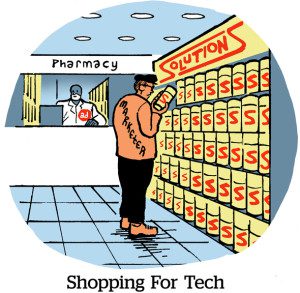
Incrementality is a retail media term for attribution. It’s the attempt to measure the actual contribution of advertising to a business’ bottom line. But in a market where everything old is new and everything new has been done a thousand times, it’s important to focus on other kinds of incremental gains.

This week’s dispatch explores the new trend of false advertising class-action suits in the food and CPG industry and how the evolution of online, data-driven retail media could exacerbate the problem.

Enjoy this weekly comic strip from AdExchanger.com that highlights the digital advertising ecosystem …

In today’s newsletter: Ad blocking is getting integrated into web browsers; why Reddit needs to diversify its advertiser base; and how big media’s affiliate marketing tactics crowd specialist publishers out of search.

Commerce media is now among the fastest-growing areas of the ad industry. At the start of 2024, AdExchanger partnered with Fluent to survey more than 150 decision-makers from leading brands, agencies, and publishers serving a range of industry sectors. The results of that survey are part of a new report that provides key insights, including […]

Advertisers are turning the spigot back on. And PubMatic’s investments are paying off. The SSP reported 14% year over year revenue growth in Q4, powered by 9% growth in display.

MikMak, an ecommerce ad analytics company that began as an online add-to-cart specialist, is figuring out more and more how to get things in a physical shopping cart.

There are signs of soft consumer spending this holiday season, and retailers and big online marketplaces are pushing harder than ever to bring down prices and promote discounts.

On Monday, Omnicom entered the ecommerce marketplace services space in a big way with an $835 million deal to buy Flywheel Digital.

As ecommerce grows – and advertisers become increasingly wary of proxy measurement – newer metrics are emerging to help buyers better understand how ad spend affects their bottom line.

Is the programmatic advertising industry in a rut? Maybe just call it a midlife crisis, says JiYoung Kim, president for North America at GroupM Nexus, because there are bright spots – namely, retail media.

The US ad market will be boring next year. In a good way. Brian Wieser predicts stabilization in 2024. But if you double-click on his numbers, there are several interesting – and somewhat disturbing – trends to note.

Instacart’s S-1 makes more references to advertising than it does to “delivery,” “pickup” or “CPG.”

On Tuesday, Surfside, a cannabis-focused data and marketing platform with its own CDP and DSP, rolled out its commerce media platform nationwide.

PubMatic reported meager YOY revenue growth in Q2, up just a smidge to $63.3 million from $63 million in Q2 of last year.

On Tuesday, PubMatic entered the crowded retail media space with the launch of a self-service ad platform for commerce media called Convert.

“Performance marketing and growth hacking ruined a generation of startups,” according to Rent the Runway co-founder and CEO Jennifer Hyman.

Amazon accounts for more than 40% of retail media’s multibillion-dollar total addressable market. But that doesn’t mean there isn’t a big opportunity to scale retailer audiences across the open internet, says Criteo CEO Megan Clarken.

American retailers now see themselves as media companies. But in their publisher guise, retailers are in a strange and giddy situation.

Retail media networks overall still have a ways to go before they’re able to satisfy several basic buy-side demands, including better measurement, more transparency and some form of standardization.

The ad tech hits keep coming this earnings season. The latest is Criteo, which reported total revenue of $446.9 million in Q3 2022, down from $508.6 million last year, while net profit in Q3 dropped from $24.2 million in 2021 to $6.5 million.

What do Marriott, Lyft and Lowe’s have in common? All three are non-advertising companies that recently launched their own media platforms. Lowe’s rolled out its One Roof Media Network in October 2021; Marriott announced its travel media network in May; Lyft Media launched in August. Both Marriott and Lowe’s use Yahoo’s ad tech to support […]
Commerce and retail media suddenly became an incredible tailwind for online advertising. But anyone banking on retail media networks to power programmatic growth for years to come needs a reality check, writes AdExchanger Senior Editor James Hercher.

Yes, the headwinds are blowing for digital advertising. There’s signal loss, regulatory scrutiny, platform privacy changes and a looming recession, to name a few. But McKinsey Partner Emily Del Greco sees opportunity on the horizon for commerce media and new forms of measurement.
DTC brands are struggling to get by without the Facebook ad engine. Legacy brands are flummoxed by ecommerce. One company that’s hoping to split the difference is RoC Skincare, which spun out of Johnson & Johnson and was acquired by the private equity firm Gryphon in 2018.

There’s a disconnect between those ad buyers in the trenches of online advertising and their own corporate leaders up the C-suite, who are accustomed to determining marketing group budgets based on ROI and other basic advertising KPIs that, frankly, are going haywire right now. One way to deal with that disconnect is to add someone who speaks both languages, as it were.

Two years ago, shortly after the start of the coronavirus pandemic, Nike doubled down on what it refers to as its Consumer Direct Acceleration. Nike wasn’t simply weathering a storm, but taking COVID-19’s worldwide shakeup of consumer buying habits as an opportunity to rethink its business “by expanding our digital advantage, reshaping the marketplace of the future and creating deeper, more direct consumer relationships,” CFO Matthew Friend told investors.

Marriott is one among a platoon of non-advertising companies that have launched programmatic ad platforms lately. Just don’t call Marriott’s new platform a retail media network. “I wouldn’t put us in that category,” said Elizabeth Donovan, global director and head of ad revenue for the Marriott Media Network. “We are a travel media network and I think more like a publisher, too.”

Criteo is still using third-party cookies while it can. Why not? But “if tomorrow we don’t have access to them, then we’ll have to use something else,” said CEO Megan Clarken. What sort of “something else?” Criteo has been testing what it refers to as “more privacy-enabled, controllable and reliable signals.”