
Primed For Context; Streamers Turn A Profit, But Will It Last?
Amazon Prime Video rolls out new audience and contextual targeting; streamers wring more revenue from subscription-weary consumers; and AI is an app, so it must obey Google and Apple.
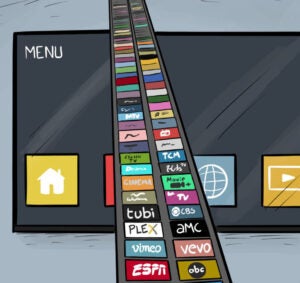
Amazon Prime Video rolls out new audience and contextual targeting; streamers wring more revenue from subscription-weary consumers; and AI is an app, so it must obey Google and Apple.

Amid the glitz of TV upfront presentations, advertising executives take the stage to talk about things like new audience targeting capabilities or to ballyhoo new ad measurement partnerships. How, though, are we supposed to focus on brand lift statistics when we can all hear Lady Gaga belting a vocal warmup offstage?

Like a pumpkin turning into an elaborate stagecoach, Disney’s programmatic ad sales have grown rapidly in recent months.

An Adalytics report released Friday details numerous instances of brands serving ads to known bots that appear on the IAB Tech Lab’s International Spiders and Bots list and TAG’s Data Center IP List.

NBC, Fubo, Disney-owned ESPN and ad agency Mindshare weigh in on the creative flexibility offered on CTV and whether sports streamers really reach incremental audiences.

US judge rules generative AI has no fair use claim; Snap sets its sights on SMBs; MMM comes to CTV; and Disney introduces ads in live TV, even for paid users.

Google’s open-source MMM product goes live; Amazon Prime Video’s ad biz turns one; and teens don’t trust Big Tech and have doubts about AI.

Nobody is acting like TikTok will actually be scrapped from American smartphones. Plus, Venu Sports got benched – for good.

Why the agency pivot to alternative payment models is good for M&A; Zeta Global responds to a short-seller’s explosive claims; and X sees a mass exodus after the election.

During its earnings call on Thursday morning, Disney announced plans to bring ESPN+ content to Disney+ starting on December 4,

IRIS.TV will remain an independent company, and Viant will push for CTV platforms to adopt its IRIS ID to provide contextual signals beyond what streamers typically share about their ad inventory.
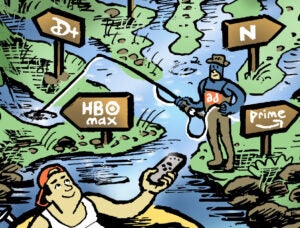
CTV advertising continues to drive significant growth for Magnite. That’s all thanks to “increasing programmatic adoption by the industry’s largest players,” CEO Michael Barrett told investors on the company’s Q3 earnings call this Thursday.

Disney redirects subscribers to its site to avoid Apple’s App Store fee; ad tech IPOs are in a lull, but the tech companies that are going public rely on ads for growth; and a Democratic PAC spent $30 million on Spanish-language ads.

The “set-jetting” phenomenon means TV advertising and, more specifically, CTV advertising is a natural fit for travel brand Expedia promote its service.
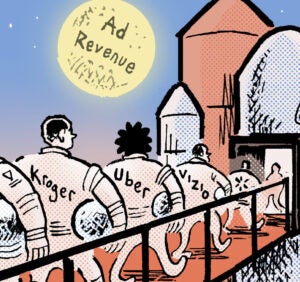
Airbnb gets one step closer to launching a retail media biz; Google shakes up its ad tech executive team; and streamers struggle to balance ad and subscriber revenues.
Winners and losers are emerging from the streaming melee. (Or at least the winenrs are.) Plus, CNN will begin testing metered content.

The bottom is falling out of the mass multichannel TV bundle. Plus, Amazon crushed its first-ever upfront this year.

In today’s newsletter: Amazon stands out among Upfronts CTV rookies; Google reveals how much revenue its ad tech divisions make; and women hold more marketing leadership positions than men, but churn is worse for women.

In today’s newsletter: Walmart’s hottest growth drivers are ads and subscriptions; why The Trade Desk’s UID 2.0 could be regulators’ next target; and how the growth of CTV content fortresses is preventing breakout streaming hits.

In today’s newsletter: How membership bundles are creating new forms of consumer-facing partnerships; typically unflappable platforms leap to action when billionaires are harmed by bad ads; and X’s GARM lawsuit helped politicize brand safety.

The SSP revised its full year outlook down by $10 million, due to a DSP partner adopting first-price auctions and weakness in key ad verticals. But it highlighted mobile in-app as a new key revenue stream.

In today’s newsletter: The DOJ sues TikTok alleging COPPA violations; Disney wraps a competitive upfronts season as it faces stiller competition for streaming ad budgets; and more than $107 million was spent on ads for AI products in the first half of this year.

The next Google Search core update is expected in “the coming weeks.” Plus, The TV industry moves slowly, but it’s going FAST now.

Upfront negotiations might take longer than normal this year. Plus, Meta is already in hot water with the EU’s new digital regulations.

In today’s newsletter: SSPs lead the way on ad tech’s M&A resurgence; Disney rolls back CPMs to court more streaming ad demand; and why dating apps struggle to grow and monetize their audiences.

The average CTV platform now authorizes 30 SSPs to sell its inventory. And one of the most noticeable effects of increased SSP saturation in CTV has been higher costs due to SSP reselling.
In today’s newsletter: How changes in streaming ad inventory could impact upfront CPMs; video cracks 50% of engagement on Meta’s platform for the first time; and Apple is in talks to launch Apple TV+ in China.

In today’s newsletter: Why Apple’s SKAdNetwork 4.0 is a bust; advertisers are irked by Google’s optimization-driven demand for different creative formats; The Trade Desk releases a baffling list of top 100 publishers.

In today’s newsletter: Ampla suspends loans to DTC brands, putting their ad budgets at risk; why Sony is investing in IP rather than a streaming platform; and Netflix will move on from Microsoft in favor of in-house ad tech by 2025.
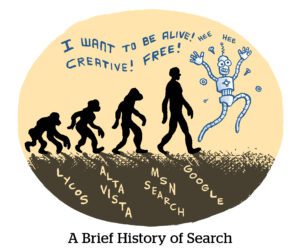
In today’s newsletter: Google’s generative search experience launches in the US; kid-focused brands worry Instagram is serving their ads to predators; Fox hypes clean rooms and shoppable TV at the upfronts.