

 Bustle has raised $38.5 million in venture capital to create content that speaks to female millennials. And it’s beginning to see its efforts bear fruit. It earned $30 million in 2016, up from just $10 million the year before.
But competition for this prized demographic is tough. The space is crowded with other digital startups, including Refinery29, with its $500 million valuation and $125 million in funding, and PopSugar, which has raised $46 million. Each publisher is making its own plays against storied women’s magazines like Glamour and Cosmopolitan.
Bustle follows the same playbook as Refinery29: an emphasis on sponsored content and no programmatic. Its banner ads resemble Mic’s, with clean white space against high-impact units, in an experience that’s optimized for mobile. And it services clients by holding their hands through optimization and focusing on campaign renewals.
Bustle is also diversifying. It launched Romper last year to reach millennial moms, and the site’s racked up 8 million uniques and brought in new advertisers.
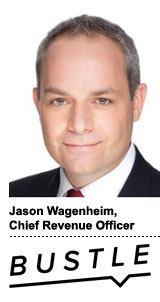
With revenue tripling over the past year, Bustle hired Jason Wagenheim to serve as chief revenue officer last fall. Wagenheim arrived after a brief stint at Fusion, which became Univision. Before that, he spent more than a decade at Condé Nast where he last served as publisher of Teen Vogue.
Wagenheim spoke to AdExchanger about what’s ahead for Bustle and digital media startups like it.

AdExchanger: What were you brought on to do?
JASON WAGENHEIM: Now that Bustle is operating at this level of revenue, we need to come up with a plan to double or triple that revenue again in the next two to three years. We are looking at higher-level selling and bigger deals, new platforms, new initiatives, incorporating editorial tentpoles into how we sell and new ad products to get to the next level.
Where is that revenue growth coming from?
Our branded and native content studio. We have an 11-person branded content team. Seventy-five percent of deals we did had a native or branded feature attached to it. And high-impact display does well for us, too. I do not think that high-impact display is dead. I think it’s thriving, and it’s thriving at places like Bustle.
Do you have a no-programmatic strategy like your competitor, Refinery29?
We ultimately will have a private marketplace strategy in 2017. A really good deal for us will be where 20% is private marketplace and 80% is a high-impact branded content campaign. Programmatic is a great way to drive down advertisers overall eCPM and provide tonnage and views, but it shouldn’t make up 100% of the plan. There is still plenty of money available for publishers like us in direct buys.
The IO-based, direct banner business is flat to declining. How is Bustle experiencing that trend?
We are three years old and never had traditional banners as part of our mix, which maybe is a strong position to come from. We started with high-impact media and custom content. And we have creative mobile and video units that work and look great on mobile, like our panoramic unit. We’ve never been up against 300x250s and 300x600s.
According to comScore data, your unique visitors are pretty flat over the past year or so, in the 30 million US uniques range. Do comScore numbers track with how you’re looking at audience growth?
Because of the inauguration coverage, comScore is probably going to show 37 million uniques in January – but when you get to 30 million you’re up against the universe of millennial women. And we don’t have a reach network.
What’s the thorn in your side right now?
My pain point is the notion that everything is shifting programmatically. There is going to be programmatic fatigue. I understand it’s a quick and easy way to transact, but those impressions are not as meaningful. Digital media should not be treated like a commodity like corn and soybeans. The best campaigns we’re executing are formed with Bustle’s DNA in mind to engage a reader. Programmatic can’t do that.
Branded content is not as scalable as programmatic. So brands often create a mix of the two. Do you find you’re in competition to win that one RFP for the branded content, or is that space expanding?
In the women’s space there is a room for one or two publishers max to win a big direct campaign. The rest is going programmatic or to video or Facebook or Google. I do think programmatic has a place in the private marketplace format, where it’s used as a mechanism to distribute branded content widely. Or used as tonnage to bring down eCPM.
Native ad renewals can be a challenge. MediaRadar did research showing they averaged 33%.
Everyone can sell a campaign once. We are uber-focused on renewal rates and client retention. We are keenly aware of an advertiser’s KPIs going into a campaign, and we have a crack team of ad ops people making sure that campaign goals are being met. When they’re not, we speak up mid-campaign and come up with plans to optimize along the way. Client services is very important when there are so many people competing for the same pot of money.
Will digital video give publishers the opportunity to pursue a cable TV-type model with platforms like Snapchat, OTT providers or telcos like Verizon?
I definitely think this will happen. Brands like Bustle belong on TV. We will have an OTT strategy we will roll out this year. And I do think the platforms will pay us for that content. There is a need for amazing content created by talented people who have a relationship with the audience. We hired Kate Robinson from Viacom, and she is working on our video distribution and OTT strategy now.
What trends are you seeing in terms of how buyers are reaching out to you?
There is definitely a lot more accountability. Viewability standards remain high. We are being asked about cost-per-engagement numbers, video views, content views. We’ve shifted on some level to a CPV [cost per view] model for branded content. We are ready for it and fully transparent with any data that we can be.
What happens between Facebook and publishers this year?
I think we will continue to be incredible frenemies. One-third of our traffic comes from Facebook. It’s an awesome place to discover our content. What I hope Facebook will do more of is providing monetization opportunities for publishers like us. Mid-roll video will be important to us, and so will how we use Facebook to distribute branded content. They are benefitting from having our content on their platform, as we are, but I would love to work together to find easier ways to monetize the content together.
This interview has been condensed and edited.






