

Vevo uses YouTube for a large chunk of its distribution and viewership.
A joint venture between Sony Music Entertainment, Universal Music Group and Warner Music Group, Vevo creates and distributes more than 330,000 music videos across YouTube and its owned-and-operated channels. Vevo gets access to YouTube’s massive audience, and YouTube gets a cut of the revenue.
With 30 million viewers per day and 116 million per month in the US, according to comScore, Vevo has a valuable audience to sell.
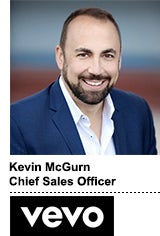
“We package up the top stars in the world and sell that to advertisers,” said Kevin McGurn, chief sales officer at Vevo. “The mass majority of what we do is on audience and the media around it.”
Vevo’s valuable audience and artist relationships have allowed it to thrive through YouTube’s brand-safety debacle. It sustained reach and traffic on the platform, even when YouTube consolidated Vevo subscribers under artists’ accounts in January.
Vevo has maintained 20-30% growth for the past few years, and its inventory recently became available to a broader base of buyers through Googled Preferred.
“We’re a growth story in what is otherwise a massive amount of shrinkage in TV,” McGurn said.

But YouTube isn’t the be-all and end-all for Vevo. While the network has allowed music labels to capture many of the eyeballs that left networks like MTV and VH1 during the rise of the internet, Vevo is still vying to bring them back to the living room.
“YouTube is the largest video search engine in the world, but DirecTV Now, Sony PlayStation Vue and others have the potential to allow users to curate their own music video experiences,” McGurn said. “We watch them closely and think about how we can maximize that.”
He spoke with AdExchanger.
AdExchanger: How do you differentiate your sales strategy on YouTube?
KEVIN MCGURN: We sell sponsorships against the catalog we represent from Universal Music and Sony – the audience Vevo represents – as a standalone. In most cases, brands buy us first and then go to Google Preferred to get that broader reach.
Most buyers see us as well-differentiated as a legacy, and we enhance that with new products. For brand safety, we offer advertisers the ability to buy on TV content ratings.
We also offer guaranteed reach. Marketers have asked for a long time to limit the frequency of their campaigns. We’re able to fulfill that and transact on it. That helps us differentiate from the traditional go-to-market for Google Preferred.
Did your reach take a hit when YouTube moved all of Vevo’s subscribers from your channel to individual artist accounts?
We haven’t seen tremendous fluctuation in traffic. We track with the growth rate of YouTube because we’re such large percentage of their viewership. It fluctuates with channels and creators, but we have so many channels and so much content on a weekly basis [that] our growth continues to be strong.
How did YouTube’s brand-safety issues affect you?
We’re probably beneficiaries of the changes. YouTube is making maneuvers that will point to a video that’s brand-safe and monetizable. We would be that video in many cases.
We’ve always been brand-safe. We have the world’s largest celebrities. We have a network of folks looking at every video before it goes live and algorithmic curation.
How do you balance the traffic you drive to YouTube versus your own site?
I look at YouTube as an MVPD much like Comcast or DirecTV. At the core, it’s just SEO – trying to figure out ways for the recommendation and search engines to point to your videos more than others. That’s standard practice on YouTube. The platform is fairly agnostic to the buyer. We try to grow all of the channels that we think are relevant to the end user.
What could cause your YouTube traffic to decline?
A change in the algorithm. YouTube is trying to optimize for the most time spent and the highest traffic. They have a lot of controls to point people in the direction of content they feel might get a higher level of engagement.
The influx of content can change how much you’re getting shown. The recency and frequency of video uploads is a good indicator of viewership. We have a pretty eternal spring of content based on our partnership with music labels, so we ride above that ebb and flow that other markets might suffer from.
Brands hate that you can’t measure advertising on YouTube. What metrics are available to you?
We generally just sell audiences measured by Nielsen. I know about the other struggles with who gets to measure what inside the walled garden. There’s definitely more work to do. By no means is measurement where we want it to be.
What can YouTube do better as a media platform?
User-generated and premium content should be treated differently. The production quality, expenditure and talent that professional content represents should be separated.
I’m not a proponent of training viewers to skip advertising. I don’t think it represents the appropriate tax a user should pay to access professional content. YouTube doesn’t offer the ability to change the amount of skippable or TrueView ads called to professional content. That should be a control of the content provider, not the platform, regardless of the user experience.
The economics of MVPDs are a nod toward the production quality and spend it takes to generate these videos. It’s why you don’t see full-length TV shows on YouTube or Facebook. They don’t have an economic equation that warrants a multimillion-dollar episode production.
Why work with them if they don’t treat your content fairly?
It represents the largest distribution opportunity in the world. A music video is ripe for piracy if you don’t allow it to exist on the biggest-reaching platform. You want people to access it in a brightly lit environment.
But that environment has to treat it differently than user-generated content. I would never say YouTube isn’t the right place for music videos. It just so happens that YouTube has been the only game in town for the past 12 to 13 years, but that could change.
What would Facebook have to do to get you to spend with them?
Facebook Watch will drive interesting competition. As other platforms get that partner program business model, the ecosystem can benefit in a big way. It’s a matter of whether Facebook can get the deals in place that the music labels need. And it hasn’t opened up yet to lots of creators.
Speaking of the living room, what’s your OTT strategy?
OTT is dominated by apps today, but tomorrow it will be dominated by aggregators. There’s a natural progression of distribution we want to be on the front end of. It’s early days, and we’re having conversations.
This interview has been condensed.
Follow Alison Weissbrot (@AlisonWeissbrot) and AdExchanger (@adexchanger) on Twitter.






