For as long as most of us in digital media can remember, professional publishing has relied on a fragile assumption: If you build a destination – a site, an app, a channel – audiences will come. And if you have an audience, you can make content publishing economics work through advertising, subscriptions or some mix of the two.
Cracks in that assumption began to form in 2007 when social platforms started to mature beyond user-generated content.
YouTube moved first with its revenue-sharing Partner Program, although the real catalyst followed eight years later when Facebook launched Instant Articles with The New York Times, NBC News, The Guardian and others. Around the same time, Netflix, Amazon, Roku, Hulu and the broader streaming ecosystem exploded. Once platforms realized content was the product, they lost the incentive to send users elsewhere.
Distribution collapsed inward.

For a time, audiences struck a workable balance between aggregation platforms and publishers’ owned and operated sites, apps and channels.
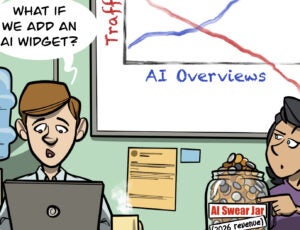
That balance broke when Google launched AI Overviews in May 2024.
Coupled with the rapid adoption of LLMs for search and discovery, referrals fell sharply, which exposed a hard truth that publishers have been reluctant to face: When discovery breaks, destination economics break with it. AI-powered search, summaries and agents removed the last remaining economic margin for error.
An existential threat to the O&O business model
Even the best content quality and brand relevance can’t fix basic P&L math. Publisher costs remain fixed and stubborn: websites, apps, ad tech, CMS, identity and consent infrastructure, analytics, billing systems, compliance … and all the people that run the business.
Meanwhile, traffic-dependent revenue is collapsing. A small number of global brands with unique and valuable content, durable subscriptions or licensing revenue may survive this transition intact. Everyone else faces an ugly reality: It no longer makes economic sense to operate a full-stack distribution business just to host content.
Publishing and distribution finally separate
Quality content still matters. Editorial judgment matters. Expertise matters. Trust matters. In some cases, that trust lives with a well-known publishing brand. In others, it lives with an individual creator, journalist or artist. But none of it inherently requires every publisher to own and operate a destination.
What must change is the assumption that content management, distribution and advertising infrastructure are strategic assets. In an AI-mediated discovery environment, websites, apps, ad stacks, subscription systems and CMS plumbing stop looking like moats and start looking like overhead.
I am not suggesting that content is dead. Creators don’t stop getting paid. What changes is that the money will flow from where audiences actually are.
Publisher economics are concentrated in value creation
YouTube pays creators because content makes the platform valuable. Spotify licenses music and podcasts because they drive subscriptions. Streaming services fund programming because content is the product. These platforms don’t compensate publishers out of goodwill; they do it because their businesses fail without content.
And so will AI platforms. To remain useful and competitive, LLMs will need access to high-quality, trusted content. And they will pay for it – through licensing, revenue share or other usage-based models – because they recognize they will become irrelevant without it.
There can be no doubt that the revenue impact on publishers will be appreciable if not dramatic. This is why non-differentiated operations and infrastructure must go.
Further, the industry needs some new systems to make this work at scale. There are no widely adopted rights standards, no consistent tracking and usage measurement, no transparent pricing mechanisms and no trusted marketplace through which content can be traded efficiently across platforms, agents and interfaces. Professional publishing today looks less like a market and more like thousands of small businesses each running their own redundant supply chain. Tomorrow, it’ll be exclusively about the value of original, quality content. The rest is a commodity.
Coming to terms
The publishing industry is largely in denial about how quickly this transition will unfold. Many publishers privately acknowledge that the current model is broken while publicly betting on incremental fixes and traffic recoveries. As a result, the transition moment will probably surprise us, and it’s unlikely to be orderly. Fixed costs have a way of forcing decisions before replacement economics are fully formed.
The uncomfortable reality is that we are at the beginning of the end for destination publishing. Content will still matter. Expertise will still matter. Trust will still matter. But the idea that every publisher must own the place where audiences consume that content is a relic of a different era.
The question now is which publishers recognize early enough that survival no longer depends on where content lives, but on how it’s created, licensed, distributed and valued.
Follow David Kohl and AdExchanger on LinkedIn.
For more articles featuring David Kohl, click here.