


AT&T rode into Cannes this year amid fanfare following its Time Warner acquisition, freshly rebranded as WarnerMedia. But trailing in its wake are a lot of questions around what this mega-merger means for the advertising landscape.
Intentionally or not, AT&T added to the ambiguity with its Cannes branding – or complete lack thereof. The telco draped unmarked banners along the façade of the InterContinental Carlton Hotel. Festival goers chattered. What did they mean? Why were they blank? Had AT&T left its branding in Texas?
That chatter intensified late Tuesday evening, when the flames were fueled by a Cheddar story claiming AT&T is in talks to buy AppNexus for $2 billion.
To be fair, AT&T CEO Randall Stephenson told the world this sort of thing was coming.
AdExchanger dropped in on AT&T advertising and analytics CMO Kirk McDonald in Cannes to talk about the future of advertising, the Carlton signage and, of course, that rumor.

Cheddar said AT&T is negotiating to buy AppNexus for $2 billion. The Wall Street Journal pegged it at $1.6 billion. What can you tell me about that?
There’s not going to be a comment from anyone on our team about a rumor or speculation. Cannes generates those kinds of energies. Lots of rumors, lots of speculation.
What type of technologies do you need to build?
There’s a paradox around the perceptions of the advertising industry: Now, when it’s needed more than ever before to support a free and fair internet, advertising has a bad rap.
We need to make advertising matter. When does advertising feel like it complements and supports my access to the things I care about? The structure of our organization has enabled some of that.
What’s the structure?
We provide an enablement platform for customers through mobility connections, business services and the entertainment business.
And we have an advertising business that Brian [Lesser] has been brought in to run. The advertising business needs to harness the signals of consumers’ care points, enrich it and append it to new advertising opportunities for publishers and marketers.
You need that media practice, a strong data practice and strong technology enablement to make that work. Those three legs will make up Adco, the advertising company under Brian’s leadership.
Adco. Is that the name or a placeholder?
The internal language has become Adco, Mediaco and Comco. The communications business is core AT&T, what you’ve known it to be. Mediaco is WarnerMedia. And we have affectionately started calling the advertising company Adco.
During his CNBC interview, Brian described a hypothetical ad unit – one that you don’t see on your TV but on your second device. That would seem to redefine TV advertising.
The mandate from Randall is to reinvent an advertising capability.
That means using data and technology to inform the creative canvas, the consumer experience, delivery and attribution modeling. So far, I believe that most of the capabilities we have around technology have been used ineptly, because we’re still learning them.
Why are we reliant on ad slots defined decades ago if ad slots are no longer the right vehicle?
Our starting point is TV. We’re recognized as the leader in advanced TV products. We built an amazing business out of AT&T AdWorks, and we want to keep elevating that.
Speaking of AT&T’s advertising, you have blank banners along the Carlton. There’s questions whether that’s intentional or whether you just haven’t figured out what to call the new AT&T ad unit. Why are they blank?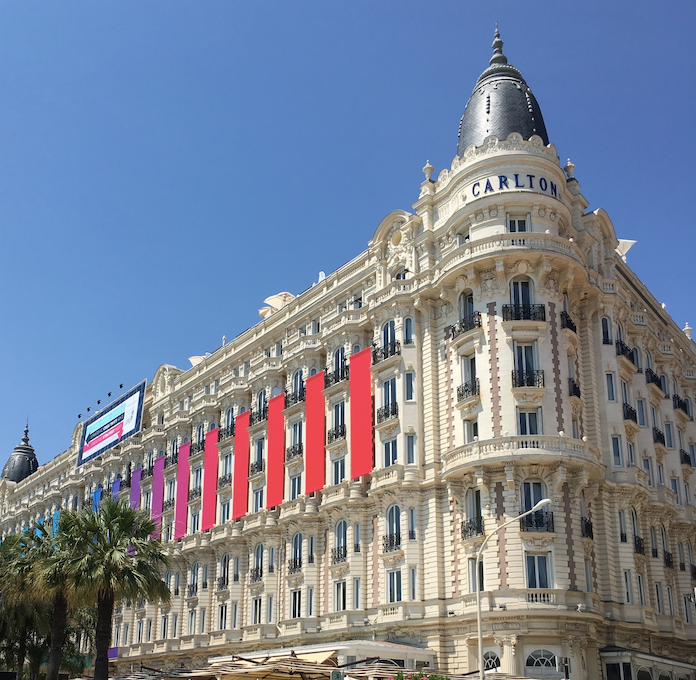
The Carlton is this iconic hotel with a beautiful façade. They’ve made available a creative canvas and it’s the responsibility of whoever has bought that canvas to be creative in the expression of the story they want to tell.
We’re beginning to tell the story of a brand reveal. But it’s the first few pages of the first chapter. Everything that was there was an invitation for curiosity. I’d rather people come away with questions about the meaning of the blue, the meaning of the transition, whether it represents a metamorphosis or a birth.
We tried it with words. It all felt wrong. But it wasn’t from a lack of knowing our brand identity. It was informed by us knowing exactly where we want to land in terms of our brand identity.
Sequencing in real life.
But isn’t that advertising? When did advertising turn into, “Hey, I’ve got something for you right now! Buy it now!” There’s no part of that where I can tease you into an invitation. This was an opportunity to try that and Brian was open to it.
[Regarding the ad experience Brian Lesser described on CNBC], we’re curious to know what a mixed-reality feeling would evoke when we don’t stop your 60-inch but inform you to engage through your three-inch. Let’s try it and learn together. Those are the opportunities we think we have.
AT&T-Time Warner is pretty unique, but there are two other companies with some similarities: Verizon-Oath and Comcast-NBCU. What lessons can you learn from those two mergers?
We share this understanding that the solution requires bringing together a relevant distribution platform, along with unique content, data and technology.
Our approaches are all different. I don’t know the end of the story, so I can’t put a grading on their approaches. Verizon-Oath is taking a digital path. Comcast, through their acquisitions and strategy, is committed to TV. I know what ours is going to be.
We touch 170 million [direct-to-customer connections across AT&T’s wireless, video and broadband businesses globally] and went after the strongest content library of premium, well-produced entertainment content. Now the advertising company has to deliver on the future of this advertising product.
What’s your goal at Cannes?
We have robust business with advanced advertising products in TV. Our data-driven linear products and addressable TV products are what our conversations have been about.
We’re here to continue talking about that. We have a lot of customer successes now, where customers are shifting more budget into our addressable TV products.
Another big part of this is the opportunity to explain the responsibilities around data and the promise of this platform, in terms of our new advertising capability.
From a marketing standpoint, we’re cracking the chapters of what it means to brand this new advertising company. One of them is the treatment on the Carlton. One of them is the introduction of the new Relevance Conference. Those are the early chapters.
Are you going to announce the name in the next chapter? Or anything else?
I don’t know of any good movie director who tells you the ending of their movie.
They tell you the movie release date.
The release was when we wrapped the Carlton. If I told you more, since part of the story is the when, I’d be giving it away. This is like “Game of Thrones,” dude. You have to wait. We’re learning from our sister company.
Interview has been edited and condensed.







