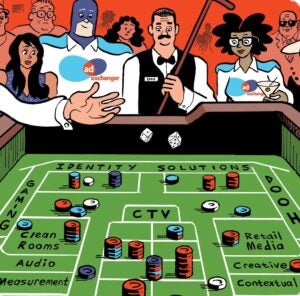
On paper, the OpenAP consortium makes perfect sense: TV networks banded together to stave off growing competition from the walled gardens.
In reality, it’s a bit more complicated.
Although OpenAP still counts three powerhouse publishers among its ranks – Viacom, NBCU and Fox – a founding member, WarnerMedia, left the group in April to compete on its own for advanced TV dollars.
That raises the question: Can broadcasters really work together as friends – or, more likely, some flavor of frenemy – for the greater good of the ad-supported TV industry?
David Levy, OpenAP’s new CEO, thinks so. “I’ve made this career bet, because it’s something the industry needs – and something it’s capable of doing,” said Levy, a co-founder of true[X], the digital video ad platform acquired by 21st Century Fox in 2014.
Levy spent nearly three years at Fox post-acquisition and a couple of years on the OpenAP board before making the jump to full time at the consortium a few months ago.
“Is what we’re trying to do here easy? No, and it never will be,” he said. “Each company has different objectives and internal needs. But, for the most part, the folks around the table realize the benefit of working together, and they’re willing to compromise to get it done.”
Just this week, OpenAP announced a partnership with NCC Media, an ad sales group co-owned by Comcast, Cox and Charter, that will allow national advertisers to buy OpenAP audience segments across NCC inventory.
AdExchanger spoke with Levy about the barbarians at the TV industry’s collective gate, what to expect from OpenAP’s forthcoming buying platform and why outcome-based measurement is interesting but won’t scale.
AdExchanger: How would you describe OpenAP’s vision?

DAVID LEVY: OpenAP is the realization that we all need to be around the table if we’re going to reduce waste in this industry, improve the user experience and create standardization. That’s better for advertisers, and it’s better for us, because it creates scale for anything that an advertiser wants to do.
What challenges are you facing?
The ad-supported content industry is facing some major issues. We’ve put all of our focus on making money, which translated to sticking more ads in people’s face – and it’s a cycle that’s incredibly disruptive to the premium content industry. We’re starting to see consumers vote with their eyeballs by moving to ad-free content.
But there are actually two opposing forces at play here: the ad-free content providers like Netflix and Amazon competing for time and attention on one side, and Facebook and Google pushing billions of highly-targeted impressions into the market on the other.
At Fox, we were investing heavily in technology to deal with this across three areas: creating a better way to reach a person, making sure it’s the right ad and then having the right methodology to measure and optimize. But we quickly realized that we wouldn’t be very successful on our own. There’s no reason to push the ball up the hill yourself when other networks are experiencing the same challenges and also making their own investments.
Viacom, Fox and NBCU are huge inventory owners, but there are a lot of other broadcasters out there. Are you wooing any to join up?
We didn’t spend a lot of time on publisher conversations last year, because we were so focused on building our product. If we build a better-quality product, then more publishers will want to come on board.
Speaking of product, when will OpenAP 2.0 be ready for primetime?
We’ll be running multiple betas throughout the summer and launching at the beginning of the broadcast year. Everything will be live by Oct. 1. OpenAP 2.0 will have a UI where advertisers can actually build segments taking into consideration reach, frequency and budget size. We’ll get that information through our API and come back with an optimized plan, like an RFP response that shows the unduplicated reach for those segments across all networks.
This is unique in that there are a lot of platforms out there that have limited access to a few titles on these networks, but this is for all of the inventory across both linear and digital.
We’re also developing APIs to plug into agency buying systems and certified demand-side platforms. The plan is for us to be an open marketplace as much as possible.
Broadcasters are starting to experiment with selling based on outcomes, but is that even scalable?
This is a market that’s been trading billions of dollars on a currency that doesn’t even get close to approximating the value of impressions or reach. Everybody realizes that needs to change, that we need to get closer to the actual goal of a campaign and then measure that.
What does that mean? There are different interpretations. One is a push to attribute purchases from a brand campaign – but it’s ineffective if the goal of the campaign is awareness or changing perception. Looking at outcomes is an ineffective way to measure high-funnel brand campaigns.
That doesn’t mean attribution studies don’t have value, but it’s only in specific use cases. Measuring outcomes won’t be the solution we need to change the way we buy and sell media in the TV industry.
This interview has been edited.