

“On TV And Video” is a column exploring opportunities and challenges in advanced TV and video.
Today’s column is written by James McLoughlin, director of data science at Inscape.
Smart TV viewing data can measure the viewing habits of a target audience, but not everyone who integrates it into a targeted marketing campaign realizes the benefits.
Only by investing time to understand both IP matching and segment behavior can the vast potential within the TV viewing data set be unlocked.
For example, analyzing the viewing patterns of households with members of a segment called “cooking enthusiasts” reveals that they watch a lot of Bravo TV during Monday night prime time. Using this information, advertisers may decide to buy heavily in that network’s prime-time slots to maximize exposure to this segment.

Unfortunately, they may not see an expected lift in conversion compared to random broadcasting across other networks and dayparts. This can lead to the incorrect conclusion that TV viewing data is of limited value, when the root cause may actually be a flawed IP matching methodology.
The real reasons for a lack of possible lift can be boiled down to five possibilities.
Reason 1: Incorrect IP matching
A broken or flawed IP address matching methodology is the most difficult problem to diagnose and repair. One of the many benefits of smart TVs is that IP addresses act as household identifiers given the infrequency with which TVs switch locations.
The household TV IP address links all internet-enabled household devices, providing access to cookie and segment data, which offers valuable insight into that household.
Issues arise when device IP addresses are incorrectly matched to the household TV IP address, spawning incorrect cookie allocation and subsequent targeting to a phantom or unrepresented segment.
A common mismatch occurs when mobile devices are incorrectly assigned to the household because the device has not accessed the household IP address frequently enough to attach it to that household IP with confidence.
Stale cookies may also be assigned to a household, leading marketing efforts to nonexistent segments. Or a reassigned IP address may be tagged with segments that belonged to the IP’s former household.
Reason 2: High segment overlap
Households typically have multiple occupants, leading to the existence of many different segments per household.
The following mix could represent a small percentage of the total segments belonging to a household of four:
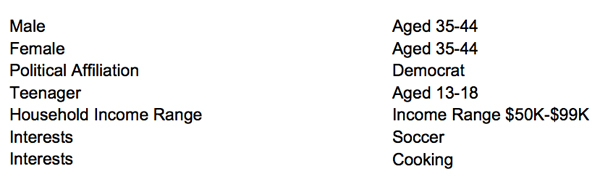 Taking this at face value may lead to an incorrect conclusion that the IP matching was wrong or segments themselves were of limited value.
To mitigate this, the household TVs that only belong to the segment of interest must be isolated carefully to ensure a large enough TV sample remains for statistically significant viewing behavior. In many cases, analyzing households containing only the segment of interest isn’t possible, and a minimal blend of segments is required.
Once the expected viewing behavior is seen in a sample of TVs with a small number of segments, all other household TVs that contain that segment of interest can be included.
Reason 3: High segment similarity
It’s unrealistic to expect big differences between a 35- to 39-year-old male segment and a 37- to 42-year-old male segment with similar incomes. This often leads to incorrect conclusions about definition or IP matching.
There may also be little difference in viewing behavior between the segment “married women” versus the segment “parents with children.” We know that not all married women have children, nor is every parent married. But it’s common for data providers to take a single segment and take it to market multiple times.
Reason 4: Vague or poorly defined segments
Poorly defined segments are evident when a segment’s name and its implied behavior are out of sync. For example, certain characteristics may identify a segment as “Spanish,” but some of those could also apply to the general population.
Is a Spanish segment so called because its members are Spanish speakers, enjoy Taco Bell or have visited Mexico? While intuitively it should be the first, I’ve seen all three used as reasons to include these people in the Spanish segment.
Reason 5: Coverage of the TV population
Segments that cover a high percentage of TVs will resemble the general population and are therefore of limited value if the goal is to specifically target a population subset to achieve a lift over random targeting. Targeting people who eat fast food occasionally will not generate any lift over indiscriminate targeting, for example, since the vast majority of the population enjoys occasional fast food.
Just as it is imperative to start with accurate data to make informed business decisions, it is critical that marketers recognize flaws in TV segments. Understanding the interaction and integration among household segments, including potential pitfalls, will give marketers a competitive advantage and empower them to gain maximum benefit from this valuable targeting mechanism.
Follow Inscape (@inscapeTV) and AdExchanger (@adexchanger) on Twitter.


