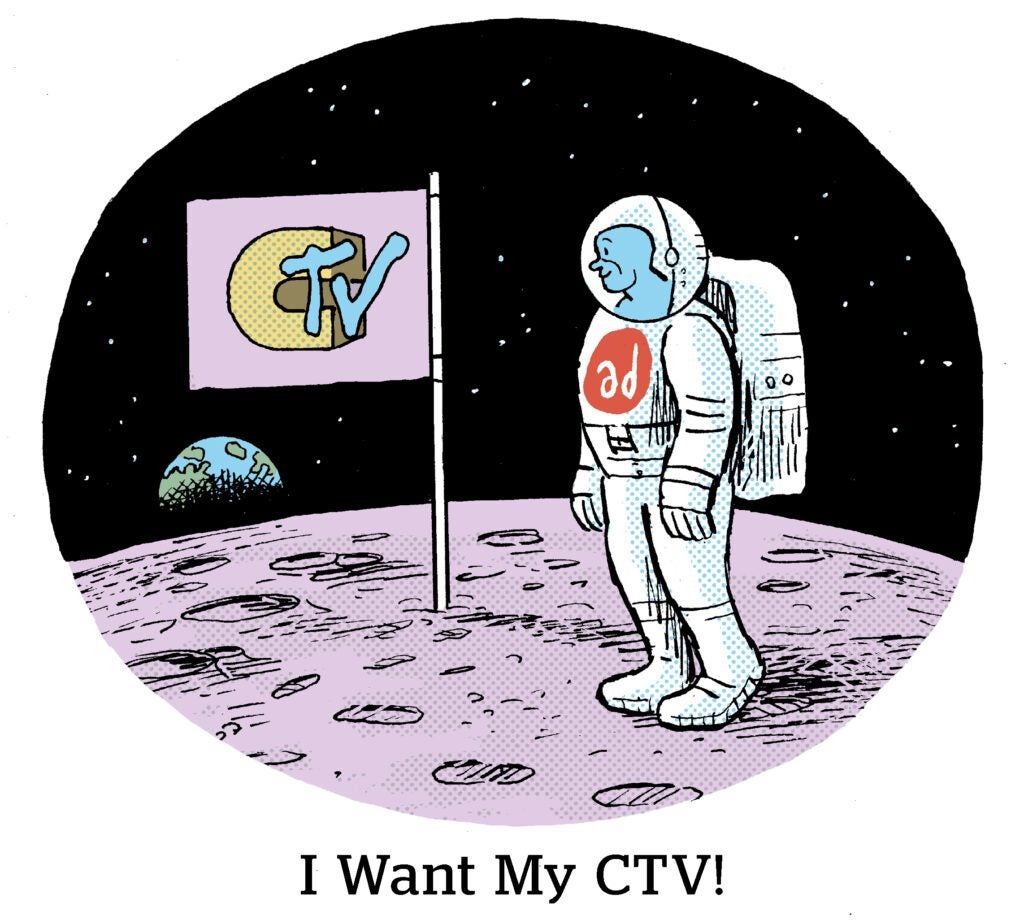
Ask five people in ad tech to define “CTV” – or any other streaming-related three-letter acronym – and you’ll get five different answers. The IAB wants to fix that.
“CTV,” for example, can refer to a cable channel streaming on an internet-connected TV or to a YouTube video on that same screen. Viewers, meanwhile, would probably just call both experiences “watching TV.”
On Thursday, the IAB announced a new framework called the Redefining Media Types (RMT) Standard designed to help the industry classify – and, more importantly, openly discuss – different aspects of the growing digital video marketplace.
The IAB Tech Lab helped develop the technical specs and will maintain them going forward as companies adopt the standard.
RMT is open for public comment until August 7, with a finalized version set to be released later this year.
Top-down and bottom-up
Ironically, the project was first inspired by the IAB’s upcoming annual video ad spend report, said Jamie Finstein, VP of the IAB’s Media Center.
Respondents had questions about how the survey defined various terms, and when those same questions surfaced in other IAB working groups, the team realized that defining terms was a larger challenge worth tackling on its own.
The working group for the RMT framework began meeting in January and includes measurement experts, streaming product leads, chief investment officers from major holdcos and members of the Media Rating Council.
The framework has two layers. “Media type categories” organize video inventory based on how audiences engage with content, and “operational attributes” describe how each media type is bought, planned and measured by advertisers on a more technical level.
Media type categories account for impression-level attributes, like whether the sound is on or ads are skippable, as well as how viewers are engaging with the content. Are they leaning back and watching on a big TV screen, on a smaller personal screen like a laptop or phone or are they walking by a digital display in a train station or some other public setting?
The viewer might be seeing the exact same ad content on all three of these screens, but the actual inventory and delivery mechanism is different, as well as the way the person experiences it.
Although the user experience is not always as different as one might think. For example, the RMT working group had frequent discussions about short-form versus long-form content and whether people are more engaged after an hour of TV-watching or an hour of phone-scrolling, Finstein told AdExchanger. In the end, they concluded that the larger ad opportunity is mostly the same in both situations.
On the operational side, however, the differences are more concrete and broken down into buckets like data signals (probabilistic versus deterministic), content context (genres, program length), device types and addressability.
Media planners are more concerned with these attributes in their day-to-day work, but there’s a good reason why consumer viewing category comes first in the framework, Finstein said. It wasn’t an arbitrary decision.
“We have a habit of losing sight of what matters to a consumer and how a consumer behaves,” she said. “We wanted to make sure to think about the consumer viewing experience first and foremost.”
The impact
Taken together, both category layers of the RMT framework will allow advertisers and publishers to more precisely label, plan and set up their digital video campaigns, said Finstein.
And the stakes will only grow as agentic AI becomes a more prominent part of the media buying process. “If the humans aren’t speaking the same language,” she said, “there’s no way to train the models or expect the agents to be able to understand one another.”
Beyond that, the IAB’s hope is that more exact terminology also helps with interoperability and cuts down on the fragmentation that plagues the ad tech industry.
Provided, of course, that the industry gets on board with these new standards.
“I’m preaching to the choir, but that’s the thing with any IAB frameworks or IAB Tech Lab standards,” said Finstein. “If we don’t have folks adopt them, then nothing is going to change.”