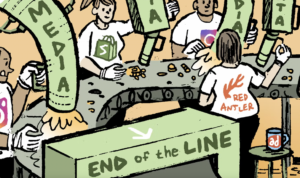


With media megamergers, acquisitions and spin-offs left and right, the media landscape is changing at a pace that is difficult to keep up with.
Here’s a recap: Earlier this week, Comcast shared plans to spin off NBCUniversal and Sky into a publicly traded company. The news follows Sky announcing plans to acquire the media and entertainment division of the European broadcaster ITV. But Comcast already separated many of its cable assets into a new company called Versant Media earlier this year.
Meanwhile, the other media and entertainment players are getting bigger by eating each other. Paramount Skydance is about to absorb Warner Bros. Discovery, while Fox prepares to gobble up Roku. Walmart wants to be a media company, too: It bought the self-serve platform Vibe.co last week to bolster TV ad sales after buying smart TV maker Vizio in 2024.
Behind all this change is a unanimous desire to capitalize on the rapid rise of on-demand streaming, according to Scott Schiller, adjunct professor of the entertainment, media and technology program at the NYU Stern School of Business and principal at S350 Media Advisors. Schiller is a media and ad sales vet who worked at MTV, Sony, Disney, AOL and Comcast. He was on Comcast’s marketing team when the broadband giant bought a majority stake in NBCUniversal in 2011.
Fifteen years later, Schiller is reminiscing on how many times he has seen companies consolidate and break up (sometimes repeatedly), as the industry scrambles to react to changing market expectations. But will Comcast’s new structure help advertisers find and engage their audiences as the rest of the industry consolidates?
That question remains unanswered, but likely not for long.
AdExchanger spoke with Schiller about what the changing media landscape means for consumers, advertisers and the future of video ad buying.
AdExchanger: What do you make of Comcast’s decision to spin off NBCUniversal amid all the media mergers and acquisitions?
SCOTT SCHILLER: Media deals such as spin-offs and mergers are financial decisions. In Comcast’s case, it is separating its assets to create two new companies that can extract value from the marketplace in different ways.
Investors need to see results and sustainable financial growth, which drives media companies’ decisions to restructure themselves. But deals like Comcast’s don’t always result in tangible benefits for the consumers.
Then, what about the recent wave of media consolidation? How might M&A affect advertisers and consumers?
Mergers and acquisitions [such as Paramount-WBD and Fox-Roku] are also financial plays. M&A clearly results in cost-cutting and efficiencies by means of consolidation. But, oftentimes, those benefits don’t always trickle down to the consumer.
The pending Paramount-WBD deal might be riskier from the lens of consumer impact because more media entities will live under one roof. That consolidation could impact consumer pricing in addition to content production. For example, if Paramount folds WBD’s streaming assets into its own, would that drive down costs for Paramount+ subscribers? Or would it ultimately cause price hikes due to less competition and higher advertiser demand for a smaller concentration of inventory? It’s too soon to say, but I always think it’s better to give consumers more choice, not less.
Media consolidation does not necessarily result in better content or higher investment in programming. Especially since the definition of premium content is evolving. Historically, the term premium used to refer to long-form, professionally produced content developed for the big screen on the wall. But nowadays, the essence of premium centers on the content that consumers actually enjoy. If some people enjoy watching cat videos, then those videos are premium to that consumer.
Speaking of cat videos, where does YouTube fit into this evolving media landscape?
YouTube is different in that it appeals to multiple types of constituencies: it’s a streaming platform with live TV programming, on-demand video and creator-made content. YouTube is like a buffet, which is confusing for an industry that is used to buying media à la carte. But YouTube also appeals to media buyers by promising the data and metrics marketers look for to prove their campaigns performed.
[Editor’s note: Whether or not YouTube actually coughs up that data is a different story.]
Now that we covered the media landscape, what are advertisers making of these changes?
When consolidation happens, there is often a tug-of-war over inventory pricing. Media companies expect consolidation to drive substantial increases in revenue while agencies expect better deals from buying multiple pools of supply in bulk from the same source.
Pricing is one example of an area where M&A deals don’t always deliver on the promises they set out to achieve for the ecosystem in the beginning. These deals are a financial transaction that benefit leadership and investors at a moment in time.
That rationale may explain why consolidation doesn’t only exist among media and entertainment companies. We’re seeing consolidation change the agency landscape, too, particularly with all the AI innovations and developments meant to maximize media value.
Maximizing ad performance is the main priority for buyers. How are you seeing this race to the bottom affect measurement?
Marketers are historically risk averse and they want to use techniques that they know work. With more technology and data available, there is more temptation to measure everything. In reality, performance means something different to every marketer, and it is very difficult to align individual campaigns with specific performance metrics such as in-store sales.
That temptation explains why every startup positions themselves with claims that they have the perfect measurement and attribution solutions. But I’m not sure that the industry is looking for the perfect way to measure their media. They’re looking for a consistent way to measure.
What do you think? Have any tips or hot takes? Let me know your thoughts. Hit me up at alyssa@adexchanger.com.