

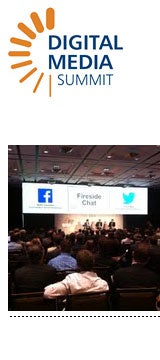
 Today, LUMA Partners gathered together ad tech executives from near and far for its annual Digital Media Summit during New York City’s Internet Week. The agenda featured a content-rich day of discussions on the corporate development and strategy side of ad tech, as opposed to the client side.
Among the highlights was a keynote by Google’s Neal Mohan announcing a “real-time” update to their benchmarking tool and foray into engagement metrics. Also, Twitter’s Director of Product for Revenue Kevin Weill made an appearance along with Facebook’s agency biz chief Blake Chandlee in a high-level fireside chat featuring LUMA’s master of ceremonies and founder Terence Kawaja.
At the end of the day-long event, there was time for one last “fireside” chat as Kawaja interviewed (and prodded) IAB President and CEO Randall Rothenberg. As the IAB chief finished explaining that Mozilla’s recent cookie-blocking moves were anything but consumer friendly, Kawaja “surprised” the crowd – and seemingly Rothenberg, too – by inviting Mozilla SVP of Business and Legal Affairs Harvey Anderson to the stage to debate and discuss Mozilla’s recent moves.
The transcript follows (MP3 here):

TERENCE KAWAJA: (To Rothenberg) Isn’t this better to have conversations that you just mentioned rather than open letters?
RANDALL ROTHENBERG: Actually, we’ve reached out to Mozilla a lot, and only when Harvey reached out to me – that was a couple of month ago – after a fair amount of back and forth. And I know our Washington teams have been in connection with you (Mozilla).
HARVEY ANDERSON: Actually, I tried to call you. You passed me off. That’s actually what happened.
RANDALL ROTHENBERG: That’s true. I passed you off.
TERENCE KAWAJA: To a summer intern… (crowd laughs)
RANDALL ROTHENBERG: I talked to Mitchell [Baker] though…
HARVEY ANDERSON: That was two years ago…
RANDALL ROTHENBERG: (Gesturing to Kawaja) Now that Harvey’s up here we don’t need you anymore.
TERENCE KAWAJA: You know what, we don’t have time for the full conversation, but I want to do three things here. Number one was have you shake hands and you’ve done that – so check the box. Number two, can each of you say, hey, I hear you, I understand your position and you’re not doing something nefarious, “other person?”
RANDALL ROTHENBERG: I can absolutely say that. I do think, however…
TERENCE KAWAJA: OK, we can check the box on that one.
RANDALL ROTHENBERG: (Gesturing to Kawaja) No, you gotta stop interrupting. If you want to do the whole thing you can.
I do think that there are people involved with Mozilla who absolutely have consumer interests at heart. That is the basis of Mozilla. I also think there are people involved with Mozilla who are seriously opposed to the advertising industry. So that has been of concern to us because, look, I believe advertising is the support structure for the free press in the United States and it’s also my job to defend it, but I’m also ideologically in favor of it. (Crowd applauds.)
HARVEY ANDERSON: I totally agree with you, Mozilla is focused on the consumer. That is our, sort of, goal is to be an advocate for the end user in their digital transactions. 100% agree. And I’m really proud of all of the people at Mozilla and all the companies that work with Mozilla to do that. The part I wouldn’t agree with you, though, is that we’re not opposed to advertising in any way, shape, or form. We like advertising and to the extent that you can deliver relevant content of all types to the user, we want to see that happen.
RANDALL ROTHENBERG: Jonathan Mayer has written some really intemperate things…
HARVEY ANDERSON: Jonathan Mayer is a contributor. He’s an individual citizen who does his thing. And he…
RANDALL ROTHENBERG: But, he’s a contractor of yours. And he’s put himself forward as the developer of…
HARVEY ANDERSON: He is not a contractor.
RANDALL ROTHENBERG: So, he’s just a volunteer who hangs around the offices?
HARVEY ANDERSON: He doesn’t hang around our offices. I actually have never ever met Jonathan Mayer.
This is the kind of actual false information…to continue to perpetuate that…It’s not good. It doesn’t really help the dialogue. For the past couple of months, we’ve spent a bunch of time talking to folks in this ecosystem to understand how some of these technical challenges could affect them. And to make changes – “if we wanted to do this, how could we do this better. How could we support frequency capping? How could we actually improve some of your other problems – attribution. What are the things that we could do with the technology – with the user engagement to make it a better experience.”
RANDALL ROTHENBERG: …I think that’s fantastic. And I know that these conversations with you and Tom Phillips and others have been very, very valuable. Really, publicly, thank you. I support you for that. And, more of it. That would be great. And, we will absolutely, to the degree that we can, contribute. We think that can lead to a win/win.
TERENCE KAWAJA: So, can we conclude with one promise? Can you promise to continue this dialogue?
RANDALL ROTHENBERG: Love and obey… (crowd laughs)
TERENCE KAWAJA: No, just continue the dialogue.
HARVEY ANDERSON: Let’s hug it out right now… (crowd laughs)








