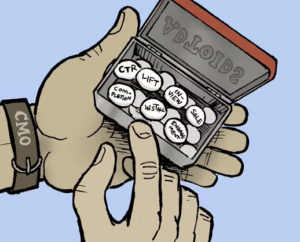
“The Sell Sider” is a column written by the sell side of the digital media community.
Today’s column is by Paul Bannister, co-founder and executive vice president at CafeMedia.
Over the last few years, there has been a steady trend toward complexity on the sell side. The growth of programmatic unleashed an explosion of innovation, with new vendors emerging to solve every potential issue.
Header bidding exchanges were only the beginning. A second wave of wrappers, analytics platforms, DMPs, dynamic flooring systems, ad quality vendors and other companies emerged. And the technical and statistical skills (and teams) required to implement and effectively use these tools continues to increase with every new release.
Now, for the first time in quite a while, there are changes on the horizon that could potentially simplify the way things work for publishers. Will the wind blow back in this direction? Or is complexity here to stay?

Simplicity from the mothership and beyond
Perhaps surprisingly, Google is at the center of the shift toward simplicity.
Google has made significant strides to unify its sell-side ad stack over the last two years. It merged the previously separated DoubleClick for Publishers (DFP) and AdX into Google Ad Manager, and unlike many other rebrands, this has been a serious effort. Exchange-specific tools such as private auctions, preferred deals and other elements have been seamlessly integrated into a single interface. Inventory pools are becoming completely unified and overall management of a publisher’s ad stack now has fewer significant headaches.
Next on Google’s road map is the transition to first-price auctions. As the sole remaining ad exchange using second-price auctions, Google’s reluctance to move not only encouraged significant gaming via flooring strategies on the sell side because of its “last-look” advantage, but created unnecessary complexity for publishers dealing with multiple auction types.
By moving to first-price auctions, Google creates a nearly completely unified, final auction. While there are new flooring strategies to be employed in this world, it massively simplifies the equation for many publishers. And likely not overlooked by Google, the move will probably accelerate the demise of many second- and third-tier ad exchanges that will lose share – and their margins – to Google.
The final piece of Google’s simplicity trifecta would be the rumored restrictive new rules for third-party cookies in Chrome. While this change isn’t being driven by its ex-DoubleClick division’s push for simplicity, the death (or near death) of third-party cookies will hasten advertisers’ interest in contextual targeting.
With third-party cookies dying, retargeting and other cross-web behavioral targeting tools will become significantly less useful, and contextual targeting will push onto the stage as the premiere targeting technology. Context is the key area where publishers have a major leg up over ad tech firms and complexity at large. Who better understands content than publishers?
Beyond Google’s initiatives, the other major trend that will create more simplicity for publishers is the drive toward identity services. If the promise of these solutions is realized, publishers would gain significantly better access to advertising budgets, with no real increase in their technical workload as the bulk of the heavy lifting would be handled by the ad exchanges.
While not a true simplification, a major monetization benefit with no increase in complexity is a rare entity indeed. While identity platforms may be hindered by crumbling third-party cookies, there should still be enough benefit to publishers for it to be worthwhile.
Complexification
On the other side of the coin, there are many trends within the industry that will lead to even more complexity and fragmentation. Some trends are just continuing the norms of the last five years, whereas others are entirely new trends that publishers must be cognizant of.
On the business-as-usual front, the exchanges have added more than 10 new adapters to the Prebid wrapper project in about the last six weeks alone. Some are updates to earlier connections, but many are new connections – ostensibly new ways for publishers to earn money. While in some ways that seems great, “We’re really lacking in potential monetization partners” is not a statement ever uttered by publishers.
While many have pressed for programmatic to support more advanced units than standard IAB banners, sometimes you need to be careful what you wish for. A proliferation of new media types have emerged in the last 18 months that can be transacted programmatically, including outstream, native, interscrollers, miniscrollers, adhesion footers and more.
This has meant new revenue opportunities but also has created new intricacies for publishers to navigate. How many high impact units per page? Which units can run in which slots? Is that high-impact adhesion footer compatible with the one I already run? The list of questions goes on.
And finally, there are the acronyms that send chills down any seasoned publisher’s spine: the continued ramifications stemming from GDPR (CMP updates, legitimate interest clarifications, etc.) and plans to get ahead of CCPA.
While these privacy initiatives are well-intentioned to protect consumers from the misuse of their personal data, they create massive complexity and uncertainty for publishers. As the ultimate controller of customer data, publishers must navigate highly unclear and enigmatic guidelines that could easily put their entire businesses in danger. While there may be some positive outcomes for publishers with respect to these regulations (more contextual targeting!), it’s more likely that it will increase publishers’ operating costs and drive more revenue to the walled gardens. A Gordian knot of a riddle wrapped in an enigma.
While it’s refreshing that there are finally some clarifying decisions being made to simplify publishers’ operations, there are some dark linings to these silver clouds, such as buy-side bid shading removing many benefits of a unified auction. These challenges, along with the normal continuation of more complexity, means publishers are likely in for more of what the last five years have looked like.
Follow Paul Bannister (@pbannist), CafeMedia (@CafeMedia_) and AdExchanger (@adexchanger) on Twitter.