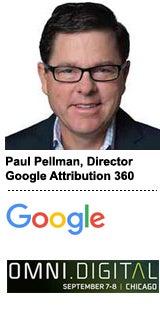
 Google’s Paul Pellman will speak at AdExchanger’s Omni.Digital conference in Chicago on September 8.
Since Google acquired attribution company Adometry two years ago, it has sought to bridge the measurement gap between mobile, offline and digital conversions.
Adometry gained more interoperability with other Google media and measurement products in March, when it was assimilated into Google’s new six-product suite dubbed Google Analytics 360, as well as better data access.
“We’re now able to leverage the Google device graph within our attribution solution, which allows us to access data across seven different products, each with over a billion logged-in users,” said Paul Pellman, director of Google Attribution 360 and former CEO of Adometry. “That kind of large-scale deterministic data gives us a much more accurate view of user-level activity.”
Pellman spoke with AdExchanger about the pains and gains in achieving proper attribution of marketing spend as more data enters the mix.
AdExchanger: How is Adometry different under Google ownership than as a standalone point solution?
PAUL PELLMAN: Before we were acquired, we differentiated ourselves on a data-driven model, and the fact that we were the first in market to [link] offline conversions with cross-device data. We were seen as one of the leaders in the marketplace because we were attacking things ahead of the curve and I think that’s one of the reasons Google acquired us.

What has Google added, resourcewise and datawise?
One is the unique data asset we have available and the other is the ability to integrate more seamlessly within other measurement solutions in the Google universe [like] the media planning and execution stack DoubleClick. Nearly four years ago, we first started talking about cross-device tracking. To be able to use our own data now through the Google device graph allows us to take that to a whole higher level of accuracy and comprehensiveness. That allows us to better understand media performance than other folks who don’t have access to that data asset.
We were also very quickly able to launch a TV attribution product that the Google team had created right before we were acquired that leverages search query insights to understand TV performance.
How do you answer critics who say Google’s strength is in web analytics for advertising, not digital marketing and CRM?
We understand digital’s influence within a broader market mix model better than most other folks mostly because we understand digital well. We’ve been early proponents of bringing offline conversion data typically seen in CRM systems and tying that together with digital data so we can understand media performance. Our DMP solution understands characteristics of a client’s best customers so we can create targeted lookalike modeling for more efficient and effective marketing.
How have some of Google’s advancements on the commerce side with Shopping Ads influenced your work in attribution?
We have unique data assets. And this is relatively new: We’re leveraging geolocation data to use as a proxy for conversion.
We can [gauge] what subset of consumers go to a respective [auto] dealer within a certain time frame based on geolocation data. We haven’t leveraged that in our attribution product yet, but it’s something we’re looking to do. It’s an interesting way to bridge the online-offline gap.
How would that work?
If a retailer has a robust database of in-store purchases, we can map a physical address or email to a cookie [using LiveRamp] to help clients understand how their media is converting outside of pure online activities.
The challenge is match rate issues [with cookies]. The benefit of geolocation data is [the volume of] how much of it we have. The only challenge is, you don’t know if a person bought or not, you just know they went to a location. But it’s an interesting proxy and it’s another layer of insight. We’ve always looked at attribution as moving things closer and closer to the perfect answer.
How do you do that with your auto dealer clients today?
To date, all of our conversion data has been tracking site activity – did they look up a dealer or configure a car? But the ultimate goal is to get a person into the showroom so they can start looking, feeling and touching a car and seeing if it’s a car they want to buy.
What other retail data sets are interesting to you?
I’ve already talked about what we’re doing with LiveRamp, but there are similar opportunities to do the same thing with some of the grocers’ frequent shopper data. When you have a large penetration of consumers and all the SKUs of products they’re buying in a grocery or drugstore tied to a physical mailing address, companies can activate that data with LiveRamp and match it to a cookie base. Voila: You can help Pampers understand how their digital media is driving people in-store to purchase.
The interview has been edited for clarity and length.