

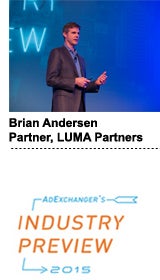
 The combination of behavioral and database marketing is giving rise to the predictive marketing platform, said Brian Andersen, partner at investment bank LUMA Partners, during a presentation at AdExchanger’s Industry Preview show Wednesday.
The predictive marketing platform is unique in that it connects different functions like CRM, commerce systems and web analytics, and adds machine-learning algorithms to personalize offers.
“Data-management platforms (DMPs) are critical for this industry, but they were generally designed for large segments,” said Andersen. “Predictive marketing platforms will incorporate email, retargeting and CRM.”
In the past, DMPs and web analytics systems were considered behavioral targeting tools while CRM and commerce technologies, rooted in transactions and loyalty, were for database marketing. But the technological walls are crumbling.
Companies like TellApart, Andersen said, meld the two. By factoring in a predictive analytics engine and things like product-level data, a marketer is able to anticipate the next message or piece of creative to show consumers.

Companies like AgilOne have coined terms like “Predictive Marketing Cloud” and position themselves as an alternative to the emerging enterprise-marketing stack in some respects. These companies seemingly have an advantage over some of the larger enterprise stacks, not all of which incorporate media execution directly.
While a large brand marketer’s CRM database may live in-house, it may opt to run most of its media executions through a third-party agency partner for its TV buys or a specialized network for retargeting, Andersen said.
Enterprise marketing providers like IBM might have the commerce, analytics and campaign management, but they must partner to provide ad targeting.
But as the lines between paid, earned and owned media blur, marketers might force enterprise marketing vendors to add more execution capabilities.
“There are separate media teams and email teams within different clients, but we do see teams changing their behaviors,” said Alex Hooshmand, VP of product management for the Oracle Marketing Cloud, during an Industry Preview panel called “The Changing Digital Marketing Technology Landscape.” “People and process come first and platform comes last.”
Ultimately, integrating media into enterprise marketing requires more than simply adding a new application.
“Our technology is generally well integrated, but it’s not just about software,” said Suresh Vittal, VP of product marketing and strategy for the Adobe Marketing Cloud. “You can’t drop a piece of software and say, ‘Now you’re a customer company.’”
And, fundamentally, it depends on the vendor’s vision.
“Digital 1.0 is a crazy hunt for cookies,” claimed Mike Lazerow, the chief strategy officer for Salesforce.com’s Marketing Cloud, which he referenced as the Customer Success Platform. “Our [focus] is very different. It’s broader, it includes sales and BI, data, mobile apps, customer journeys.”







