


Facebook is lusting after lucrative online travel ad dollars.
And on Thursday, Facebook launched its next assault on the travel industry – encroaching further on Google’s turf – with the global rollout of Dynamic Ads for flights.
The release will allow airlines and flight advertisers to retarget users across Facebook, Instagram and Audience Network with ads tied to browsing behavior on and off the platform.
Advertisers are able to bring their own data to the table, including activity on their mobile site, app and website.
The addition of the flight vertical rounds out Facebook’s Dynamic Ads for travel offering, which Facebook developed last year to help hotels and destinations generate bookings.
Travel marketers spent almost $6 billion on digital advertising in 2016 in the US alone, according to eMarketer, while digital travel sales are expected to hit $755.9 billion by 2019.
Google Flights, Google’s search engine for travel, already generated at least $12.2 billion from travel advertisers last year, but Facebook’s play is that it’s a place where people go to converse with their friends and family about travel plans.

Now, Dynamic Ads for travel and flights allows Facebook to edge in when consumers are ready to book – which is increasingly happening on mobile. A research study conducted by GfK for Facebook last September found that 85% of travel is planned on a mobile device.
“People come to us every day to discover and talk about what matters to them,” said Christine Warner, Facebook’s US industry head for the travel sector. “And then Dynamic Ads for travel capture people when they express interest in your brand with clear intent about where they want to go.”
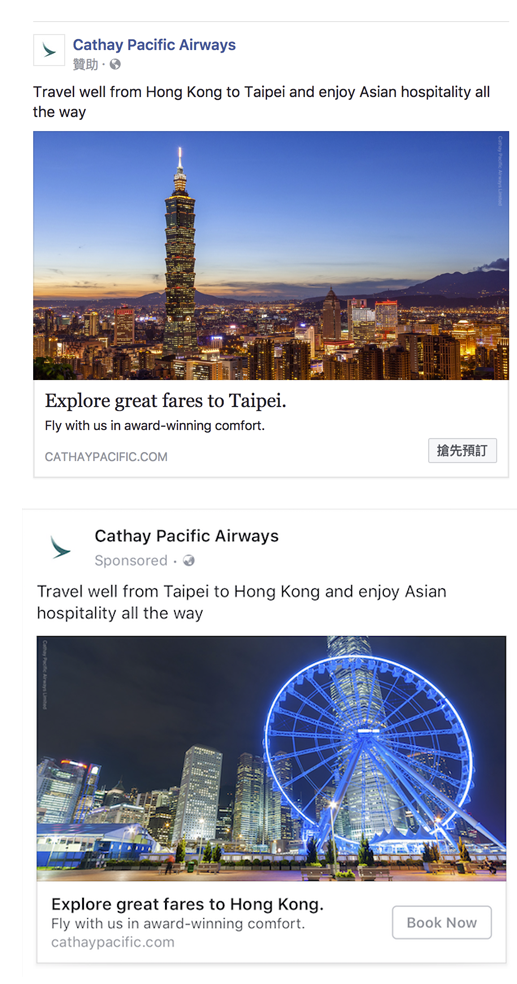 Cathay Pacific, an early beta tester of dynamic flight ads, has seen a sixteenfold increase in booking volumes and a 15% reduction in its cost per acquisition. Delta is also using the product.
For now, the only creative formats available are static images and carousels, although video is something Facebook would consider down the line, Warner said.
Tackling flights in a dynamic ad format is a complex endeavor. The ads need to take origin and destination into account, as well as the continually fluctuating price of flights.
Airlines can either share specific flight prices pegged to time windows or enable Facebook to target individuals based on the pixel fire that happens before serving an ad that’s dynamically aligned with that person’s last search.
As to where flight advertisers are seeing the best results – Facebook, Instagram or through Audience Network – Warner demurred, saying it’s too early to tell and that “it very much depends on the objective.” But it’s fair to assume that native ad experiences on the core Facebook and Instagram properties yield the best outcomes.
Facebook first launched Dynamic Ads in 2015 to enable retailers to place retargeted ads in the news feed based on what users looked at on the marketer’s site or app. The travel and flight versions are an offshoot of that.
In the first quarter of this year, Facebook marketing partner Nanigans saw a 33% uptick from last quarter in the share of ad spend going to Dynamic Ads across ecommerce companies. Year-over-year growth was 62%.






