

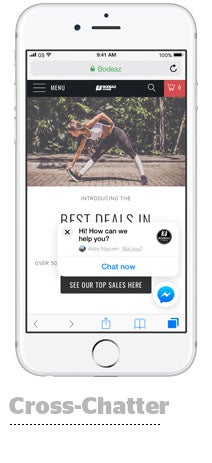
Messenger hopes to insinuate itself deeper within the customer journey.
On Tuesday, Facebook released a closed beta test of a customer chat plugin as part of Messenger 2.2 that allows businesses to continue a single conversation thread across multiple channels, including Messenger and an advertiser’s own mobile and desktop sites.
Businesses that integrate the customer chat plugin can resume chats that initiated on Messenger through their websites and vice versa. Creating one ongoing chat cuts down on conversational friction, said Kemal El Moujahid, lead product manager for Facebook’s Messenger team.
Out of the 70 million businesses with a presence on Messenger, more than 20 million use the platform to actively communicate with their customers. Messenger is up to 1.3 billion monthly active users.
Although people are increasingly turning to live chat to handle customer service issues rather than email or picking up the phone, there’s “a lack of identity and a lack of continuity,” El Moujahid said.
Even if a customer has a pre-existing relationship with a brand, that person needs to log in or self-identify in some way for the brand to be aware. And if the customer closes out the chat or leaves the website without completing the interaction, the thread is lost.

“The experience is broken and having to log in or give credentials wastes time trying to establish context,” El Moujahid said.
The idea with the plugin is to allow businesses to keep the chat going regardless of platform with “identity built in,” he said.
Brands can also retarget within chat experiences on their site using info gleaned from Messenger, including the products that users may have previously showed interest in. The retargeting works both ways.
“Say someone is looking for shoes on a site,” El Moujahid said. “The business can see I’m interested in the shoes and they can ping me later to ask if I’m interested. They can also ping me about the shoes on Messenger.”
The stickier Messenger gets, the more questionable the role of a brand’s standalone app, especially with the rising costs of user acquisition and retention. On that point, El Moujahid was cagey.
“What we hear from developers is that they’re excited about the possibilities being opened up with Messenger,” he said. “They can do customer care more efficiently and they get the benefit of our footprint. The customer chat plugin is just another footprint we’re adding for advertisers who have optimized their web pages.”
For the moment, the plugin is only available on the web and the mobile web. Depending on how the beta shakes out, apps might be on the agenda next, but it’s too early to say.
Beta partners on this go-round include Air France, KLM, Argos, Adore Me and online fitness apparel retailer Bodeaz.
Facebook also released an assortment of other features as part of Messenger 2.2 on Tuesday, including the ability to append call-to-action buttons to videos, images and GIFs and additional languages – Chinese, Dutch, French, German, Italian, Polish, Portuguese, Romanian, Spanish and Vietnamese – for its built-in natural language processing technology.
On Friday, Messenger announced its plans to open sponsored messages, which businesses can use to retarget users and bring them back into existing chats, to all advertisers within the next few months. Until now, sponsored messages were only available to a small number of advertisers.
Unlike click-to-Messenger ads that appear within the app’s home feed, sponsored messages can only be sent to people who have already communicated with a business.








