

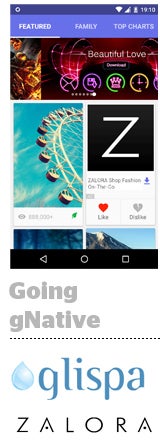
 When it comes to native, Zalora cares about context.
The Singapore-based online fashion retailer, whose app has been downloaded more than 5 million times since 2014, has been working with German mobile marketing company glispa to integrate native placements into its app experience.
Glispa, which started life as a user-acquisition and engagement network, has been plugging away at a native ad solution, dubbed gNative, which the company took out of beta on Wednesday.
When Zalora uses gNative to advertise itself in related apps, it’s looking to stand out while fitting in.
It’s all about providing “a positive, relevant and rich user experience to the end consumer without causing interruption or intrusion,” said Kaushal Bhalotia, Zalora’s head of online marketing.
That’s also the definition of native, according to Gary Lin, CEO and founder of glispa, whose other clients include Hasbro, Sega, King.com, Gameloft, Baidu, Match.com, Warner Brothers and Brazilian fashion etailer Dafiti.
“A lot of people look at native in too limited a way. They think about it as the look or the feel or the color or creating some kind of frame around an ad that has certain characteristics,” Lin said. “And that’s all true to an extent, but the ultimate goal of native is utility – utility that fits into the form and flow of the hosting app.”
Glispa’s native offering is centered on contextual placements and product recommendations that aim to blend into the surrounding content, including ads that integrate directly into content feeds and ads that create a mini app store-like experience.

But it’s not just about look and feel, said Robert Wildner, VP of media ops at glispa. User data, including behavior, device time and previously installed apps layered with in-app data provided by the developers themselves fuel glispa’s recommendation engine.
In the case of Zalora, for example, it would make most sense to only target the highest-quality users most likely to convert within specific parts of the app, say the featured section or the new arrivals section.
According to Bhalotia, Zalora has seen good early results with the tool, including an accelerated volume of installs and viable end users.
As a performance-based network, glispa monetizes on a cost-per-install basis. Once the install is complete, the company’s optimization engine kicks in. Post-install events like in-app purchases, subscriptions and performance by day, time and ad placement are tracked among glispa-generated users to drive more app traffic.
And scale has been growing. Glispa claims that gNative reaches an audience of more than 1 billion users, up from 643 million last quarter, delivering in the neighborhood of 9 million app installs monthly.
Glispa, which turned over a majority stake in its company to ecommerce vendor Market Tech Holdings in March, is still running as an independent entity, said Lin, who noted that Glispa has M&A on the mind, especially around re-engagement and CRM-related tech.
The company, which has a headcount of roughly 150 people spread across Beijing, San Francisco, Tel Aviv, London, Bangalore and its Berlin headquarters, hopes to hit the 200 mark by the end of the year. A new office in Sao Paulo is also on the way.







