


 Episode, a choose-your-own-adventure storytelling app, is choosing a road to revenue centered on the user experience first.
 Monetization is delicately balanced with the demands of UX for the interactive app, which allows users to immerse themselves in fictional narratives.
“But there is a lot of revenue to be made if we can get people engaged,” said Michael Dawson, Episode’s studio head, who described Episode’s in-app experience as “native bite-sized consumption.”
Developed by Pocket Gems, a San Francisco-based game studio which snagged $90 million in funding from Chinese internet giant Tencent in March, Episode houses more than 3 million animated mobile stories, the majority of which are user-generated.
A handful of the most engaged-with stories, however, were created in collaboration with celebrities like Demi Lovato and TV and movie studios. Two of the most popular storylines on the platform are based on “Pretty Little Liars” and the “Mean Girls” franchise.
Since 2014, Episode users have watched more than 3 billion episodes, which according to Dawson translates into about 57,000 years of viewing time, and the app’s monthly active user base of 5 million weekly actives is primarily made up of young women 13-25, a demo that’s highly attractive to advertisers.

And multiple online forums feature users who minutely discuss the characters, rehash storylines and share spoilers.
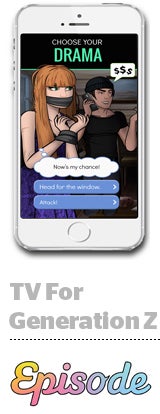
Users create avatars to participate as main characters within the stories, tapping through screens of animated dialogue and answering multiple-choice questions to move the story along. The trajectory of the plotline depends how users react to the options they’re presented with.
“Think of it like Netflix with Hollywood-caliber storytelling meets Snap in a native mobile experience,” Dawson said.
A combination of advertising and in-app purchases power Episode’s monetization engine, although Dawson declined to share the revenue split.
The basic in-app experience is free to download and play, but users can buy gems to unlock potential plotlines or move through stories with a faster cadence. Inside the “Pretty Little Liars” narrative, for example, users can pay to customize their avatar’s look with special outfits.
Episode also recently rolled out an ad-free-for-a-fee model as an experiment.
“We want to give our viewers a meaningful choice in how they experience us, to let them define the experience they want while still allowing us to be able to afford to support the production of great content,” Dawson said.
Once users start to engage with the app, loyalty is exponential, he said. The more stories a viewer engages with, the stickier the experience gets and the longer they retain.
But Episode still needs to attract users in the first place. Instagram and Snapchat have proven to be particularly fertile channels for user acquisition, considering their visual nature and Episode’s youthful demo.
It’s not easy to explain what Episode is in static banner ads, which is why the app is moving away from display and embracing video.
Story clips and trailers that home in on a moment of drama within a plotline (“Someone is chasing you down a corridor – do you keep running or stop and fight?”) work best to demonstrate the in-app experience. Episode works with a number of video ad networks and is also starting to experiment with playable ad units.
“Anything we can use to help bring our stories to life is something we’re interested in,” Dawson said.
Episode applies the same philosophy to data collection. Data at the aggregate level enables the app to unearth trends and feed those learnings back into the product to improve the overall experience.
For example, after Princess Kate had her second child in 2015, Dawson and his team noticed a lot of searches for terms like “family,” “babies,” “princess” and “royalty.” Royal babies were in the zeitgeist and Episode responded with a multi-chapter story called “Royal Baby” about an American girl who falls for the crown prince of a fictional kingdom.
“The primary thing we’re focused on is exposure and getting people to engage and re-engage,” Dawson said.
In that way, Episode is taking a page out of TV’s playbook.
“If an HBO subscriber loves a particular series, they’ll come back to watch the new season. It’s the same for us. People might go away for a little while, but when we launch a new season of ‘Demi Lovato’ or ‘Mean Girls,’ they come back to check it out, and that’s when we can monetize.”
This is the 13th installment of Home Screen, a series of profiles on mobile pubs and apps and the devs that make them (and hopefully make money on them). Read about home décor app Lux, teen voting app Wishbone, wedding planner platform The Knot, lip-syncing app Musical.ly, pop culture magazine Movie Pilot, news app News Republic, on-demand laundry app Cleanly, music streaming app LaMusica, P2P global shopping app Grabr, kid-friendly chat app Jet.me, driving app Dash, anonymous app Whisper, weather app Poncho, online writing community Wattpad and sticker app Emogi.








